
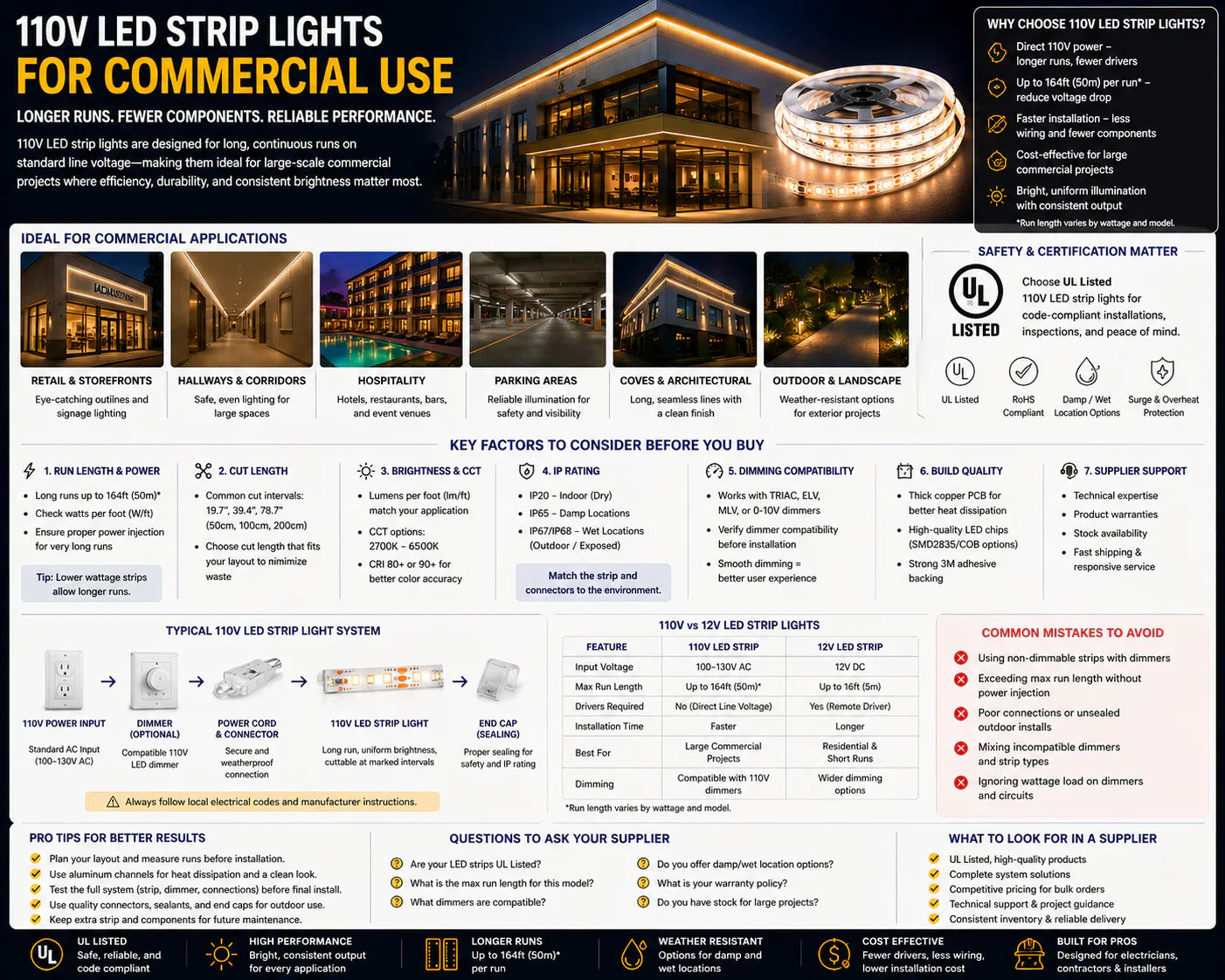
Why Commercial Projects Often Choose 110V LED Strip Lighting
When projects require long linear lighting runs, 110V LED strip lights offer a practical alternative to traditional low-voltage systems. By operating directly from line voltage, these strips can cover greater distances with fewer power supplies and fewer connection points.
For contractors, project managers, and lighting suppliers, that often means faster installation, simplified planning, and reduced labor costs.
Commercial environments such as retail centers, hotels, office buildings, parking structures, and large architectural features frequently benefit from these advantages.
The Biggest Advantage: Long Continuous Runs
One of the primary reasons commercial buyers choose 110V strip lighting is run length.
Traditional low-voltage systems often require multiple drivers, power injection points, and additional wiring as distances increase. With 110V strip lighting, much longer runs can typically be achieved while reducing the amount of supporting equipment required.
This can help simplify installations in:
• Long hallways
• Building perimeters
• Retail facades
• Hospitality spaces
• Parking garages
• Warehouse pathways
• Architectural outlines
For large-scale projects, fewer components often translate into lower installation complexity.
Where 110V LED Strip Lights Work Best
The strongest applications for 110V strip lighting are projects where long, continuous illumination is more important than highly customized control.
Common commercial applications include:
• Exterior building accents
• Storefront outlines
• Hotel corridors
• Lobby coves
• Canopies
• Walkways
• Commercial signage lighting
These installations typically benefit from the efficiency and simplicity that line-voltage strip lighting provides.
Why UL Certification Matters
Commercial projects demand products that meet recognized safety standards.
UL-listed 110V LED strip lights help support:
• Inspection approval
• Code compliance
• Project specifications
• Contractor confidence
For wholesalers and project buyers, certification helps reduce risk while making products easier to specify for professional installations.
Before purchasing, verify that certification applies to both the strip and any related accessories used within the system.
Environmental Ratings Should Match the Jobsite
Not all commercial installations operate under the same conditions.
Before specifying a product, buyers should confirm whether it is intended for:
• Dry locations
• Damp locations
• Wet locations
Outdoor architectural lighting, parking structures, and hospitality exteriors often require additional protection against moisture and environmental exposure.
The entire system should be evaluated, including connectors, end caps, and termination methods.
Why Cut Length Matters More Than You Think
One important consideration with 110V strip lighting is cut interval length.
Many line-voltage strips are designed for longer cut increments compared to low-voltage products. While this is rarely a problem on large perimeter runs, it can become restrictive when working with detailed architectural layouts.
Before placing a large order, verify that the available cut points align with the project design.
Doing so can help reduce waste and avoid installation adjustments later.
Understanding Dimming Compatibility
Not all 110V LED strip lights support the same dimming methods.
Commercial buyers should verify compatibility before installation rather than assuming any dimmer will work.
Important factors include:
• Supported dimming technology
• Existing control systems
• Load requirements
• Project specifications
Proper planning helps avoid flickering, inconsistent output, and unnecessary troubleshooting after installation.
Installation Benefits for Contractors
For installers, one of the biggest advantages of 110V strip lighting is reduced system complexity.
Benefits may include:
• Fewer power supplies
• Fewer connection points
• Less low-voltage wiring
• Faster installation times
• Simplified maintenance planning
These advantages can be especially valuable on large projects where labor efficiency directly impacts profitability.
When Low-Voltage LED Strips Are Still the Better Choice
Although 110V strip lighting works well for many commercial applications, it is not always the ideal solution.
Low-voltage systems often remain the preferred choice when projects require:
• Short custom segments
• Advanced dimming control
• RGB or RGBW lighting
• Tunable white systems
• Architectural millwork integration
• Premium residential detailing
In these situations, the added flexibility of low-voltage systems often outweighs the benefits of longer run lengths.
How Wholesale Buyers Evaluate 110V Strip Lighting
Experienced buyers look beyond price alone.
Before purchasing, they typically evaluate:
• UL certification
• Environmental ratings
• Inventory consistency
• Brightness uniformity
• Color consistency
• Accessory availability
• Dimming compatibility
• Supplier reliability
A product that performs consistently across multiple projects often provides greater value than a lower-cost alternative that creates installation or maintenance issues.
Why Inventory Stability Matters
Commercial projects often involve multiple phases, future expansions, and maintenance requirements.
Reliable inventory helps ensure:
• Consistent specifications
• Easier reordering
• Reduced project delays
• Better long-term planning
For contractors, distributors, and project buyers, dependable availability is often just as important as product performance.
Choosing the Right Supplier
The best suppliers do more than provide products.
They help buyers understand:
• Certification requirements
• Installation considerations
• Dimming compatibility
• Accessory selection
• Environmental suitability
Professional support becomes especially valuable on projects where schedules, inspections, and multiple trades are involved.
A supplier that understands commercial lighting applications can help reduce risk while improving project efficiency.
Conclusion
110V LED strip lights are an excellent solution for commercial projects that require long continuous runs, simplified installation, and reliable performance.
When properly matched to the application, they can reduce labor requirements, simplify planning, and improve installation efficiency. However, buyers should still evaluate certification, environmental ratings, cut lengths, dimming compatibility, and supplier reliability before making a purchasing decision.
For many commercial applications, the right 110V strip lighting system delivers a balance of performance, efficiency, and long-term value that is difficult to achieve with other solutions.
FAQ
What are 110V LED strip lights used for?
They are commonly used for long commercial lighting runs such as building outlines, hallways, canopies, and architectural accents.
Do 110V LED strip lights require a driver?
Most 110V strip lights operate directly from line voltage and do not require traditional low-voltage drivers.
Are 110V LED strip lights suitable for outdoor use?
Yes, provided the strip and all accessories are rated for the intended outdoor environment.
Can 110V LED strip lights be dimmed?
Many models support dimming, but compatibility should always be verified before installation.
When should I choose low-voltage strip lighting instead?
Low-voltage strips are often better for detailed architectural lighting, RGBW systems, and applications requiring advanced controls.