
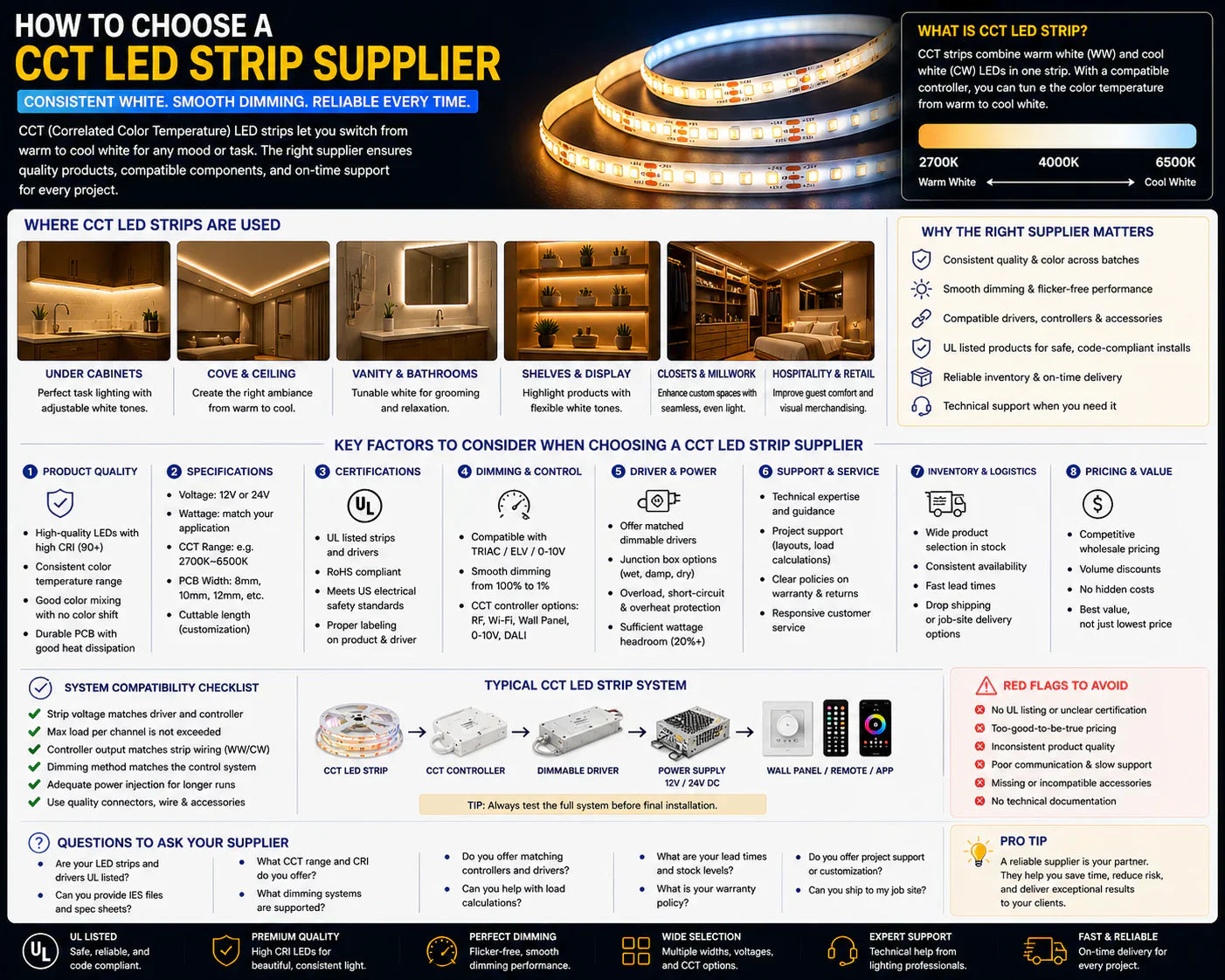
Why Supplier Selection Matters for CCT LED Strip Projects
Tunable white lighting continues to grow in popularity across luxury homes, hospitality spaces, retail environments, and architectural applications. CCT LED strips allow users to adjust color temperature from warm white to cool white, creating flexible lighting environments that adapt to different activities and moods.
However, successful CCT installations depend on much more than the strip itself. The supplier behind the product plays a major role in determining whether a project runs smoothly or turns into a series of compatibility and inventory problems.
For contractors, electricians, lighting dealers, and project buyers, choosing the right supplier helps reduce risk while improving installation efficiency and long-term reliability.
What a Professional CCT LED Strip Supplier Should Offer
At the professional level, buyers are not simply purchasing LED tape.
A complete solution should include:
• CCT LED strip lights
• Compatible drivers
• Controllers
• Connectors
• Wiring accessories
• Aluminum channels
• Installation support
Because tunable white systems require coordination between multiple components, a supplier should be able to support the entire lighting package rather than only the strip itself.
This helps reduce compatibility issues while making specification and procurement easier.
Why UL Certification Should Be a Priority
Certification is one of the first things professional buyers should verify.
UL-listed products help support:
• Inspection approval
• Safety compliance
• Project specifications
• Professional installation standards
For luxury residential and commercial projects, certified products provide additional confidence for contractors, builders, designers, and property owners.
A dependable supplier should also offer compatible drivers and supporting components that align with the same quality standards.
Why CCT Performance Is About More Than Color Temperature
Many suppliers focus on the adjustable color temperature range of their products.
While tunability is important, professional buyers should pay equal attention to consistency.
A quality CCT strip should provide:
• Smooth color blending
• Stable output across the full range
• Consistent appearance between reels
• Reliable dimming performance
• Uniform illumination
Poor-quality products may technically change color temperature but still create uneven lighting, visible diode spacing, or inconsistent output that becomes noticeable in finished installations.
This is especially important in kitchens, vanities, shelving, closets, and architectural details where lighting quality is highly visible.
Choosing the Right Strip Type
Different projects require different strip technologies.
Traditional SMD-based CCT strips continue to serve many residential and commercial applications effectively.
For projects where a cleaner visual appearance is important, COB CCT strips may provide a better solution by creating a smoother, more continuous line of light.
The right choice depends on:
• Project budget
• Installation visibility
• Profile depth
• Design expectations
• Performance requirements
A knowledgeable supplier should help buyers select the most appropriate option rather than pushing a single product category for every project.
Why Driver Compatibility Matters
Many LED strip problems are actually driver problems.
The strip, controller, and driver must work together as a complete system. If any component is mismatched, issues such as flickering, inconsistent dimming, or unreliable performance can occur.
Professional buyers should evaluate compatibility with common dimming methods such as:
• TRIAC
• ELV
• MLV
• 0-10V
A supplier that understands driver selection can help avoid expensive troubleshooting after installation.
Environmental Ratings Should Never Be Overlooked
Not every lighting project operates in the same environment.
Installations may be located in:
• Dry indoor spaces
• Damp environments
• Covered outdoor areas
• Moisture-prone applications
The strip, driver, enclosure, and connectors should all be suitable for the intended location.
Evaluating environmental requirements early helps prevent reliability issues and simplifies project planning.
Why Inventory Reliability Matters for Wholesale Buyers
A sample reel is easy to provide. Supporting ongoing projects is where suppliers are truly tested.
Professional buyers often need:
• Repeat orders
• Consistent specifications
• Stable inventory
• Multiple product widths
• Matching accessories
Inventory inconsistency can create delays, change orders, and unnecessary project costs.
For contractors, lighting stores, and project managers, reliable supply often becomes more valuable than minor differences in product pricing.
What to Ask Before Choosing a Supplier
Before opening a wholesale account, buyers should evaluate how well a supplier supports professional projects.
Important questions include:
• Are the products UL listed?
• Are compatible drivers available?
• Which dimming methods are supported?
• What strip widths are stocked?
• Can products be reordered consistently?
• Are controllers and accessories available?
• Is technical support provided?
Clear answers to these questions often indicate a supplier that understands trade requirements.
Why Premium Residential Projects Demand Better Products
Luxury residential lighting places higher demands on every component.
Applications such as:
• Under-cabinet lighting
• Toe-kick lighting
• Floating vanities
• Closet systems
• Shelving details
• Cove ceilings
make lighting quality highly visible.
Homeowners and designers notice color consistency, dimming smoothness, and overall finish quality. Small deficiencies that may go unnoticed in basic installations become obvious in premium environments.
For this reason, many professionals prioritize suppliers that focus on quality, compatibility, and long-term reliability rather than simply offering the lowest price.
The Difference Between Price and Value
Low pricing can be attractive during procurement, but experienced buyers understand the difference between cost and value.
The real cost of a lighting system includes:
• Installation labor
• Troubleshooting time
• Product replacement
• Service calls
• Project delays
Products that install correctly, perform consistently, and remain available for future orders often deliver significantly better long-term value.
The best supplier helps reduce uncertainty throughout the project lifecycle.
Conclusion
Choosing the right CCT LED strip supplier involves much more than finding a product at the right price.
Professional buyers should evaluate certification, compatibility, inventory reliability, driver support, technical knowledge, and long-term availability before making a purchasing decision.
When the supplier can support the entire lighting system—not just the strip itself—projects become easier to specify, easier to install, and easier to maintain.
FAQ
What is a CCT LED strip?
A CCT LED strip allows users to adjust color temperature between warm and cool white light.
Why is UL certification important for CCT LED strips?
UL certification helps support safety compliance and professional installation requirements.
Can CCT LED strips be dimmed?
Yes. They can be dimmed when paired with compatible drivers and controllers.
What is the difference between COB and SMD CCT strips?
COB strips provide a smoother, dot-free appearance, while SMD strips are commonly used in standard lighting applications.
Why does supplier inventory matter?
Reliable inventory helps ensure consistent specifications, easier reordering, and fewer project delays.