
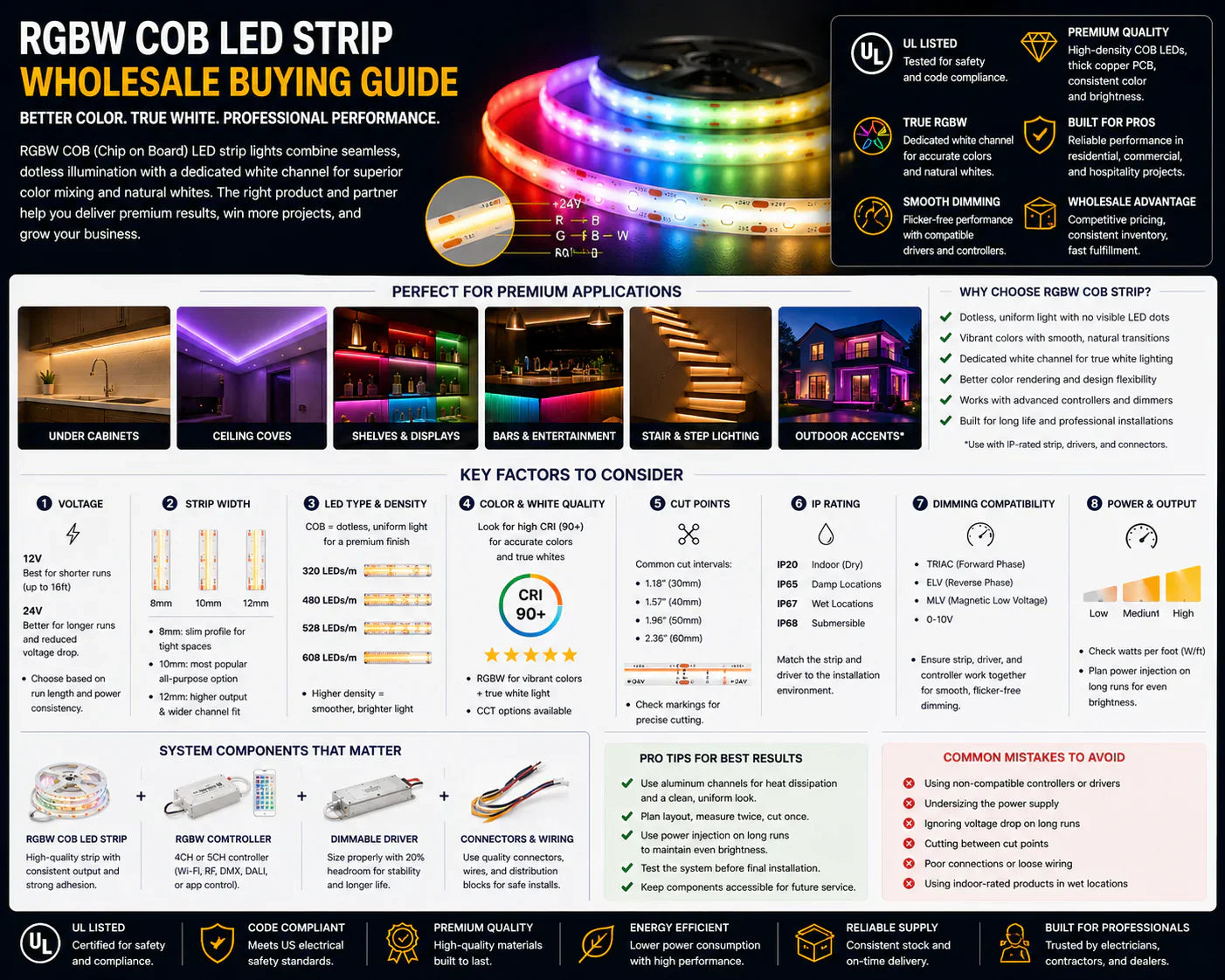
Why RGBW LED Strip Lighting Continues to Grow in Demand
RGBW LED strip lighting has become one of the most popular solutions for projects that require both decorative color and practical white light. Unlike standard RGB strips, RGBW products include a dedicated white channel that delivers cleaner illumination for everyday use while still providing vibrant color-changing effects.
This combination makes RGBW strips attractive for luxury residential projects, hospitality environments, entertainment spaces, retail displays, and architectural lighting applications.
For contractors, lighting dealers, and project buyers, the challenge is finding wholesale products that deliver consistent quality, reliable performance, and long-term availability.
What Makes RGBW Different from Standard RGB Lighting?
Traditional RGB strips create colors by blending red, green, and blue LEDs. While they can produce a white-like appearance, the result is often less accurate and less efficient than a dedicated white LED channel.
RGBW strips add a separate white LED, allowing users to switch between colorful effects and practical illumination.
This provides several advantages:
• Better white light quality
• Improved flexibility
• More lighting scene options
• Better task lighting capability
• Enhanced residential and hospitality applications
For projects where lighting serves both decorative and functional purposes, RGBW often delivers a more complete solution.
Why UL Certification Matters for Wholesale Buyers
Certification should be one of the first factors evaluated when purchasing RGBW LED strips.
UL-listed products help support:
• Inspection approval
• Code compliance
• Safety requirements
• Professional project specifications
For electricians, contractors, and lighting retailers, certified products provide additional confidence when supplying residential and commercial installations.
In large-volume purchases, certification also helps reduce risk and improve purchasing consistency.
Choosing the Right RGBW Strip Width
PCB width plays a major role in installation compatibility.
Common RGBW strip widths include:
• 8mm for compact installations
• 10mm for general applications
• 12mm for higher-output or advanced systems
The correct width depends on the channel, diffuser, mounting location, and project requirements.
Verifying compatibility before purchasing helps prevent installation delays and unnecessary modifications in the field.
Why Installation Requirements Should Guide Product Selection
Not every RGBW strip is designed for the same application.
A strip used in a floating vanity requires different considerations than one installed in a long cove ceiling or backlit display feature.
When evaluating products, buyers should consider:
• Mounting space
• Run length
• Voltage drop requirements
• Driver location
• Environmental conditions
• Control requirements
Selecting products based on the actual installation environment helps improve performance and reduce service issues later.
Why Premium Residential Projects Require Better RGBW Strips
Luxury homes often place lighting in highly visible locations.
Common applications include:
• Kitchen cabinetry
• Floating vanities
• Ceiling coves
• Stair lighting
• Home bars
• Entertainment rooms
• Custom shelving
In these environments, color consistency, smooth dimming, and reliable operation become critical.
Premium RGBW strips help create lighting effects that feel integrated into the architecture rather than added as an afterthought.
For designers and homeowners, the difference is immediately noticeable.
Controllers and Drivers Are Part of the System
RGBW lighting systems require more than just the LED strip.
Performance depends on compatibility between:
• RGBW strip lights
• Controllers
• Drivers
• Connectors
• Wiring accessories
Many installation issues occur because the strip and control components were selected independently rather than as a complete system.
Professional buyers should verify controller compatibility, driver requirements, and load calculations before finalizing a specification.
Why Driver Selection Is Especially Important
The dedicated white channel increases system complexity and affects power requirements.
When selecting drivers, professionals should evaluate:
• Voltage compatibility
• Total wattage requirements
• Dimming methods
• Environmental ratings
• Future expansion needs
Proper driver sizing helps improve reliability while supporting smooth color transitions and stable white light output.
A quality RGBW strip cannot compensate for an improperly selected power system.
Inventory Consistency Matters in Wholesale Purchasing
One successful installation is not enough.
Wholesale buyers need confidence that future orders will match current specifications and performance levels.
Consistent inventory helps support:
• Multi-phase projects
• Builder programs
• Retail inventory planning
• Contractor standardization
• Future maintenance requirements
When specifications change unexpectedly between shipments, project costs increase and customer confidence suffers.
Reliable inventory is often just as important as pricing.
How to Evaluate RGBW LED Strips Before Buying in Volume
Before placing a wholesale order, buyers should review the complete lighting system rather than focusing only on strip specifications.
Important questions include:
• Is the product UL listed?
• How does the white channel perform?
• Which controllers are recommended?
• Which drivers are compatible?
• What widths are available?
• Is inventory stable?
• Can the product be reordered later?
These considerations help reduce purchasing risk while improving project outcomes.
Why Professional Buyers Focus on Total Value
Wholesale pricing is important, but total project value extends beyond material cost.
The true cost of an RGBW lighting system includes:
• Installation labor
• Troubleshooting time
• Replacement costs
• Project delays
• Customer satisfaction
Products that install easily, perform reliably, and remain available for future orders often provide significantly greater value than lower-priced alternatives.
Professional buyers understand that long-term reliability helps protect both profit margins and customer relationships.
Conclusion
RGBW LED strip lighting offers an ideal combination of decorative color effects and practical white illumination. For contractors, lighting dealers, and project buyers, selecting the right wholesale product requires evaluating certification, compatibility, driver requirements, inventory stability, and installation conditions.
When the strip, driver, and controller are designed to work together, RGBW lighting can deliver outstanding results across luxury residential, hospitality, retail, and architectural projects while providing the reliability professionals expect.
FAQ
What is the difference between RGB and RGBW LED strips?
RGBW strips include a dedicated white LED channel for better white light performance.
Are RGBW LED strips suitable for residential projects?
Yes. They are commonly used in luxury homes, entertainment spaces, and architectural lighting applications.
Do RGBW strips require special controllers?
Yes. RGBW strips require controllers designed specifically for RGBW systems.
Why is UL certification important for RGBW LED strips?
UL certification helps support safety compliance and professional installation requirements.
Can RGBW LED strips be dimmed?
Yes. They can be dimmed when paired with compatible drivers and controllers.