
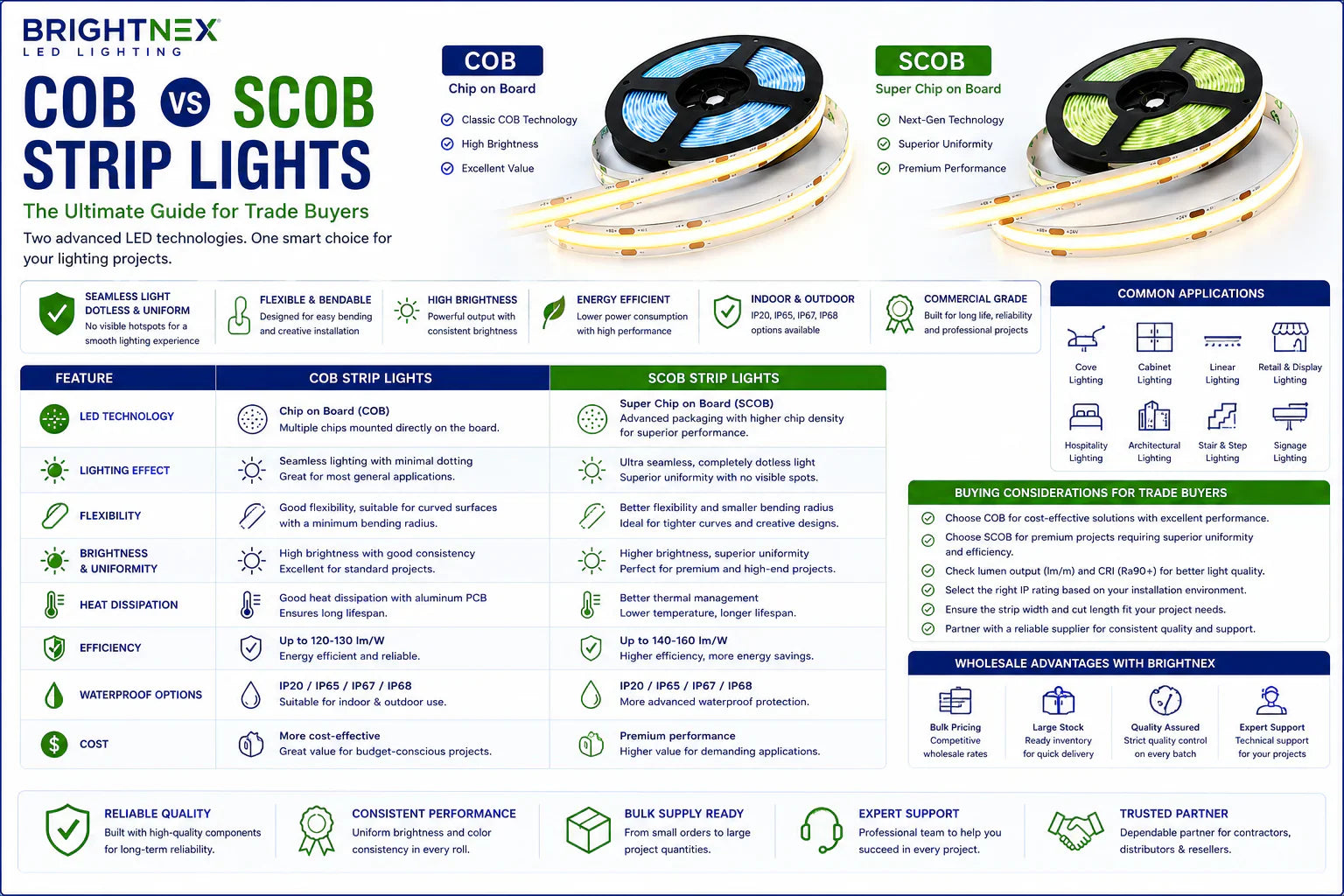
Why COB vs SCOB Strip Lights Matters
As demand grows for clean, continuous architectural lighting, both COB and SCOB strip lights have become popular alternatives to traditional SMD tape lighting. They offer improved visual performance, reduced spotting, and a more refined appearance in premium applications.
For contractors, lighting dealers, electricians, and project buyers, choosing between COB and SCOB is not simply about brightness. The decision affects appearance, installation requirements, durability, dimming performance, and overall project cost.
Understanding where each technology performs best helps buyers select the right product while protecting margins and minimizing callbacks.
What Is a COB LED Strip?
COB (Chip on Board) technology places a large number of LED chips directly onto the strip surface.
This creates:
• Smooth light output
• Reduced visible LED dots
• Better performance in shallow profiles
• Improved visual uniformity
COB strips are commonly used in:
• Under-cabinet lighting
• Cove lighting
• Floating vanities
• Shelving systems
• Architectural millwork
• Display lighting
Because of their excellent balance between appearance and cost, COB strips have become one of the most widely specified options for premium residential and commercial projects.
What Is a SCOB LED Strip?
SCOB products typically use COB technology combined with a silicone-coated emitting surface.
Depending on the manufacturer and product design, this silicone layer can provide:
• Additional diffusion
• Enhanced protection
• Improved surface uniformity
• Greater durability in certain environments
Because industry terminology can vary, buyers should always review product specifications carefully rather than relying solely on the SCOB label.
Factors such as UL certification, PCB width, IP rating, wattage, cut length, and installation requirements remain more important than marketing terminology.
Comparing Light Quality
Both COB and SCOB strips deliver significantly smoother illumination than standard SMD products.
COB strips already produce an impressive dot-free appearance in most architectural applications.
SCOB strips may provide an even softer visual effect because the silicone layer helps diffuse the emitting surface.
This difference becomes most noticeable in:
• Open shelving
• Glass cabinetry
• Visible channels
• Floating architectural details
• Luxury residential applications
For many projects, the improvement is subtle but valuable when design expectations are extremely high.
How Profiles Affect Performance
Even the best strip light depends on the profile system used.
A high-quality aluminum channel can dramatically improve appearance, heat management, and long-term reliability.
Professional buyers should evaluate:
• Profile depth
• Diffuser type
• Viewing angle
• Mounting location
A properly selected profile often has just as much impact on the final result as the strip technology itself.
Brightness and Efficiency Considerations
Brightness should never be evaluated by watts alone.
Actual performance depends on:
• Chip density
• PCB construction
• Driver quality
• Thermal management
• Installation conditions
Both COB and SCOB products are available in various output levels suitable for:
• Accent lighting
• Task lighting
• Architectural lighting
• Commercial applications
The best choice depends on the project rather than assuming one technology is universally brighter.
Heat Management Still Matters
Neither COB nor SCOB technology eliminates the need for proper heat dissipation.
For long-term reliability, professional installations should use appropriate mounting surfaces and aluminum channels whenever possible.
Good thermal management helps:
• Extend product lifespan
• Improve output consistency
• Protect adhesive performance
• Reduce maintenance concerns
This remains important regardless of strip type.
Dimming and Driver Compatibility
Many lighting issues originate from the driver rather than the strip.
Both COB and SCOB strips can deliver excellent dimming performance when paired with compatible power systems.
Common dimming methods include:
• TRIAC
• ELV
• MLV
• 0-10V
Smooth dimming depends on proper driver selection, correct load calculations, and system compatibility.
For premium residential projects, driver quality is often more important than the difference between COB and SCOB technology.
Installation Differences
COB strips are already popular because they provide premium lighting results without requiring deep channels or extensive diffusion.
SCOB products may offer additional surface protection and a more finished appearance, making them attractive for certain specialty applications.
When selecting products, buyers should review:
• PCB width
• Profile compatibility
• Environmental ratings
• Cut intervals
• Mounting requirements
Widths such as 6.5mm, 8mm, 10mm, and 12mm can significantly affect installation flexibility.
Which Is Better for Luxury Residential Projects?
The answer depends on visibility and design expectations.
COB is often the preferred solution when:
• The strip is installed within a quality profile
• Direct visibility is limited
• Budget efficiency is important
• Strong visual performance is required
SCOB may be worth the premium when:
• The strip is highly visible
• Design standards are extremely demanding
• Additional diffusion is beneficial
• Enhanced surface protection is desired
In many luxury residential projects, either technology can perform exceptionally well when properly specified.
Cost Considerations for Wholesale Buyers
For wholesalers, contractors, and lighting dealers, product selection often comes down to balancing performance and cost.
COB typically provides:
• Excellent visual quality
• Strong value
• Broad application flexibility
SCOB typically provides:
• Enhanced visual refinement
• Additional protection
• Premium positioning
The best wholesale strategy often involves carrying both options to serve a wider range of project requirements.
How to Choose Between COB and SCOB
Before selecting either technology, buyers should evaluate:
• Visibility of the strip
• Profile design
• Dimming requirements
• Environmental conditions
• Budget expectations
• Certification requirements
• Driver compatibility
The goal is not to choose the most expensive product. The goal is to choose the most appropriate product for the application.
Conclusion
The COB vs SCOB strip lights decision ultimately comes down to project requirements rather than technology alone.
Both options offer significant improvements over traditional SMD lighting and can deliver premium architectural results when properly specified. COB often provides the best balance of appearance and value, while SCOB may offer additional refinement for highly visible applications.
For professional buyers, the most successful projects come from evaluating the complete lighting system—including strips, drivers, profiles, controls, and installation conditions—rather than focusing on the strip alone.
FAQ
What is the difference between COB and SCOB strip lights?
COB uses densely packed LED chips, while SCOB typically adds a silicone-coated diffusing layer for additional protection and uniformity.
Which provides a more dot-free appearance?
Both are highly uniform, but SCOB may offer slightly smoother diffusion in some applications.
Are COB and SCOB strips dimmable?
Yes. Both can be dimmed when paired with compatible drivers and controls.
Which is better for under-cabinet lighting?
COB is often sufficient for most under-cabinet installations, while SCOB may be preferred for premium visible applications.
Is SCOB worth the higher price?
For highly visible architectural details, many professionals find the added refinement worth the additional cost.