
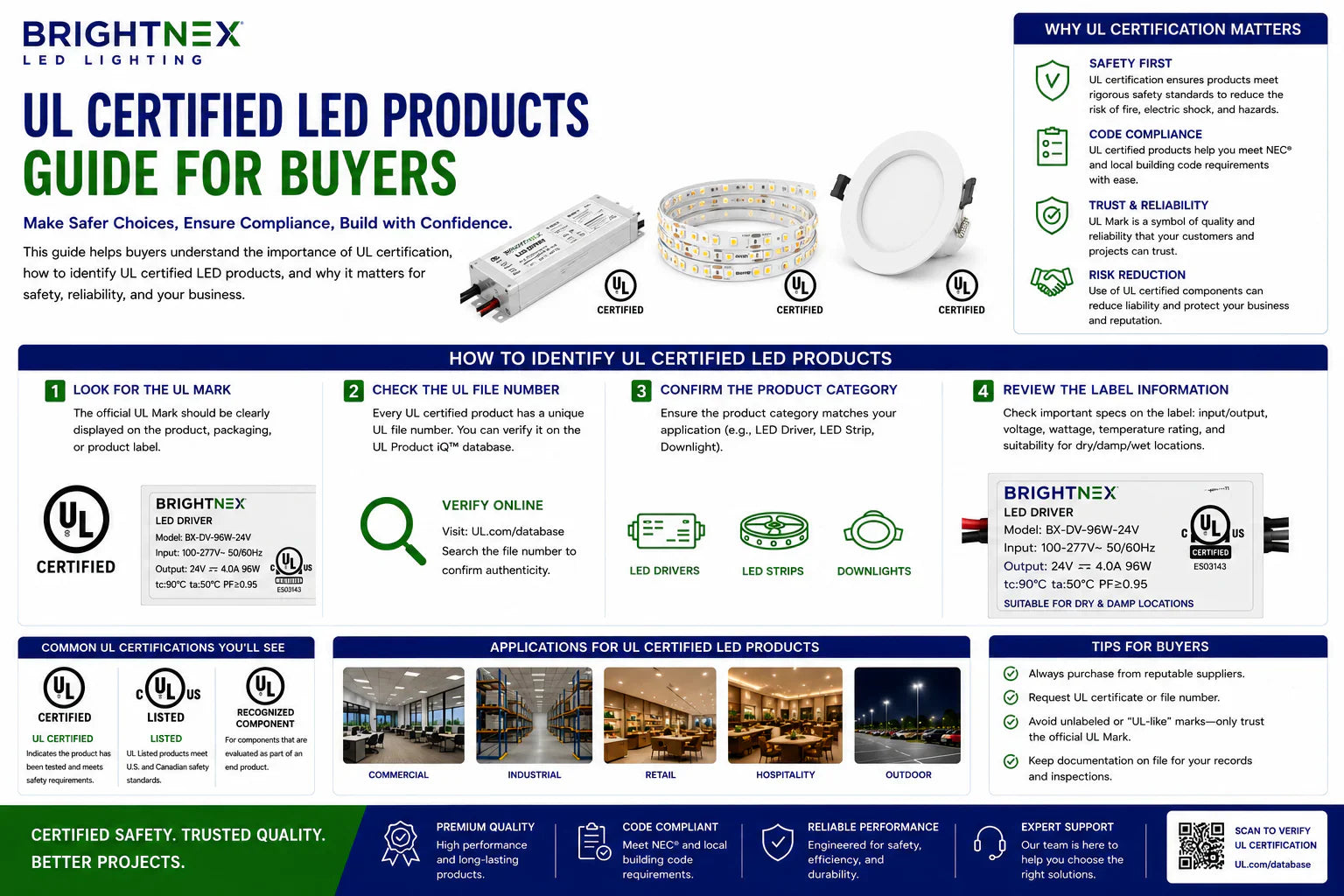
Why UL Certification Matters for Professional LED Projects
For contractors, electricians, lighting stores, and project buyers, product certification is more than a checkbox on a specification sheet. It plays an important role in safety, inspections, project approvals, and long-term reliability.
Whether the project involves LED strip lighting, recessed downlights, drivers, transformers, or complete lighting systems, certification helps reduce uncertainty and provides greater confidence throughout the installation process.
In professional environments, especially luxury residential and commercial projects, certified products often become the foundation of a dependable lighting package.
What UL Certification Actually Means
UL certification indicates that a product has been evaluated against recognized safety standards for its intended application.
For LED lighting products, certification may apply to:
• LED strip lights
• LED drivers and transformers
• Recessed downlights
• Controllers and power supplies
• Complete lighting assemblies
However, certification does not eliminate the need for proper system design. Products must still be selected, installed, and operated according to their intended specifications.
A certified product used incorrectly can still create performance issues.
Why UL Certification Matters Beyond Safety
Most buyers associate UL certification with electrical safety, but the benefits extend further.
Certified products can help support:
• Inspection approval
• Building code compliance
• Project specifications
• Insurance requirements
• Contractor credibility
• Customer confidence
For professional buyers, certification reduces risk and simplifies the approval process across a wide range of projects.
Understanding the Difference Between Product Categories
Not every LED product is evaluated the same way.
LED strip lights, drivers, transformers, and fixtures all serve different functions and may carry different certification classifications.
Professional buyers should review each component individually rather than assuming one certified component automatically certifies the entire system.
A complete lighting installation should be evaluated as a coordinated package.
LED Strip Lights: What Buyers Should Verify
LED strip lighting is one of the most common areas where specification mistakes occur.
Before purchasing, buyers should verify:
• UL certification status
• Voltage requirements
• Wattage ratings
• PCB width
• Environmental rating
• Dimming compatibility
• Product labeling
Common strip categories include:
• COB LED strips
• SCOB LED strips
• RGB LED strips
• RGBW LED strips
• CCT tunable white strips
• IC RGB addressable strips
Each category serves different project requirements and should be selected accordingly.
Why Driver Certification Matters Just As Much
Many lighting performance issues originate on the power side of the system.
Drivers and transformers should be evaluated for:
• UL certification
• Voltage compatibility
• Wattage capacity
• Dimming compatibility
• Environmental rating
• Enclosure design
Professional-grade drivers help support stable output, smooth dimming, and long-term reliability.
For projects requiring TRIAC, ELV, MLV, or 0-10V dimming, driver selection becomes especially important.
Understanding Dry, Damp, and Wet Location Ratings
One of the most common purchasing mistakes involves environmental ratings.
LED products may be rated for:
• Dry locations
• Damp locations
• Wet locations
These ratings are not interchangeable.
A product intended for dry indoor use may not be suitable for bathrooms, covered patios, exterior soffits, or other moisture-prone environments.
Professional buyers should always verify location suitability before purchasing.
Recessed Downlights Require the Same Attention
Downlights often receive less scrutiny than strip lighting, but they deserve the same level of evaluation.
Important considerations include:
• UL certification
• Driver quality
• Dimming performance
• Color consistency
• Trim construction
• Environmental suitability
In premium residential projects, smooth dimming and consistent color temperature are often just as important as light output.
Why Accessories Should Not Be Overlooked
Connectors, controllers, remotes, aluminum channels, and wiring accessories play a significant role in system performance.
Professional buyers should verify:
• Mechanical compatibility
• Electrical compatibility
• Environmental suitability
• Long-term reliability
Even a certified lighting system can experience problems if supporting accessories are not properly matched.
A Practical Buying Process for Trade Buyers
The most effective purchasing strategy follows a simple sequence.
First, define the project requirements:
• Installation environment
• Dimming method
• Light output needs
• Control requirements
Next, verify compatibility between:
• Fixtures or strips
• Drivers or transformers
• Controls and dimmers
• Installation accessories
Finally, confirm certification and environmental ratings for every major component.
This approach helps reduce risk while improving installation success.
Why Inventory Consistency Matters
Professional buyers often manage projects across multiple phases.
Reliable suppliers should provide:
• Consistent specifications
• Stable color temperatures
• Repeatable performance
• Predictable inventory availability
A product that performs well today but changes specifications later can create major challenges for future project phases and service work.
Consistency is a key part of wholesale value.
Common Buying Mistakes to Avoid
Several mistakes appear repeatedly in LED lighting projects.
These include:
• Assuming certification guarantees compatibility
• Ignoring dimming requirements
• Mixing components without verification
• Overlooking environmental ratings
• Choosing products solely by price
Avoiding these issues helps improve project outcomes while reducing callbacks and service costs.
How Professional Buyers Measure Value
Experienced buyers rarely focus on price alone.
Instead, they evaluate:
• Certification quality
• Product reliability
• Dimming performance
• Installation efficiency
• Supplier consistency
• Long-term support
The goal is not simply to purchase lighting products. The goal is to purchase systems that install correctly, perform consistently, and maintain customer confidence.
Conclusion
UL certification remains one of the most important factors in professional LED lighting procurement. While certification alone does not guarantee project success, it provides a strong foundation for safe, reliable, and code-conscious installations.
By evaluating LED strips, drivers, downlights, accessories, and environmental ratings as a complete system, contractors and project buyers can reduce risk, simplify inspections, and achieve more dependable results across residential and commercial projects.
FAQ
Why are UL certified LED products important?
They help support safety compliance, inspection approval, and greater confidence in professional installations.
Does UL certification guarantee compatibility?
No. Products must still be matched correctly for voltage, wattage, dimming, and application requirements.
Should LED drivers also be UL certified?
Yes. Drivers are a critical part of the lighting system and should be evaluated with the same attention as fixtures and strip lights.
What should buyers verify besides certification?
Check voltage, wattage, environmental rating, dimming compatibility, and installation requirements.
Are UL certified products worth the additional cost?
For most professional projects, certification helps reduce risk, improve reliability, and support long-term project success.