
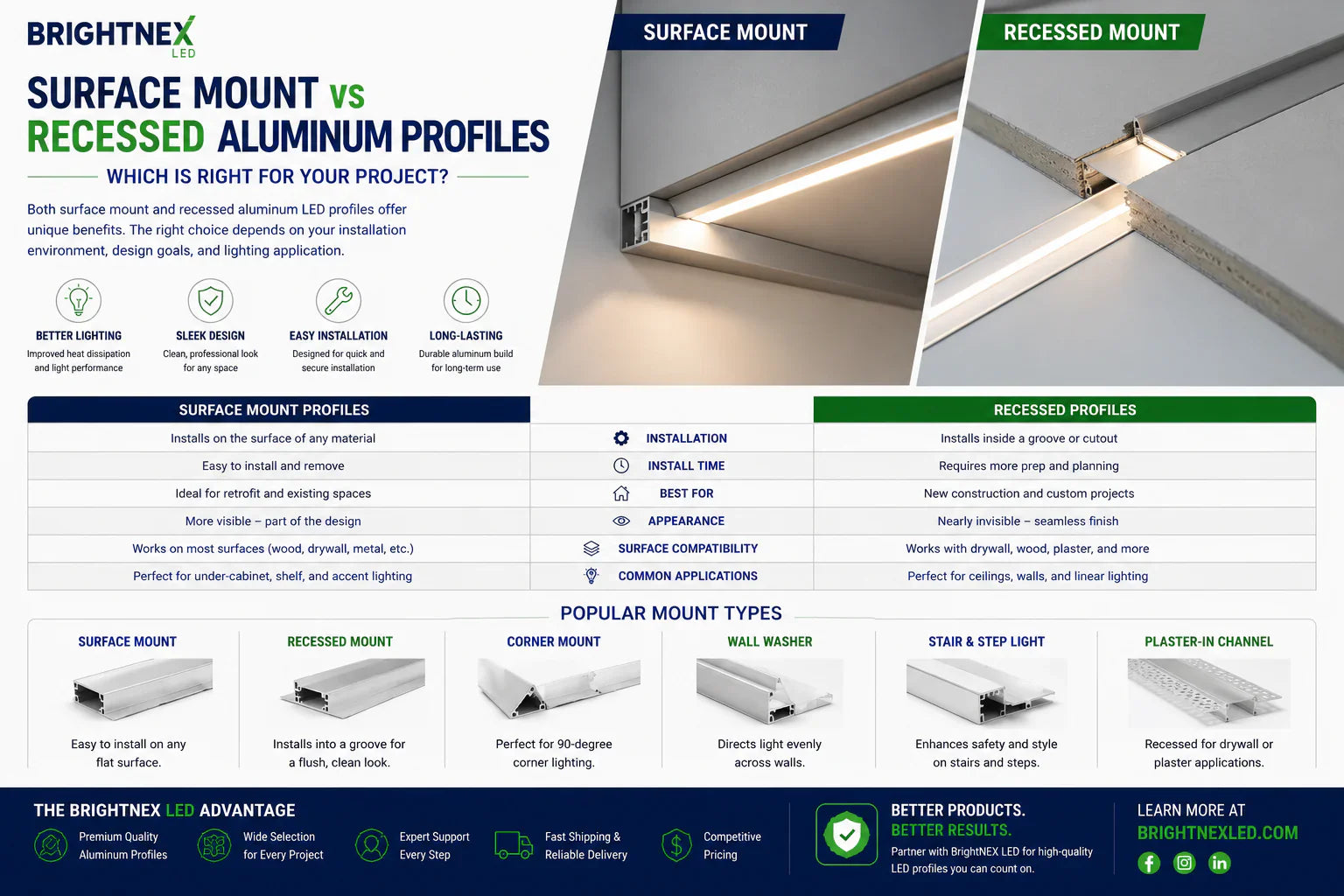
Surface mount vs recessed aluminum profiles: the core difference
A surface mount profile installs directly onto the face of a cabinet, wall, ceiling, shelf, or millwork element. It remains visible after installation, even if the lens and housing are slim. A recessed profile is set into a routed channel, drywall pocket, tile reveal, or built-in groove so the profile body sits flush or nearly flush with the surrounding surface.
That sounds straightforward, but the practical difference is larger than the mounting method. Surface mount profiles are typically chosen when installers need a clean linear lighting solution without adding labor-heavy carpentry. Recessed profiles are chosen when the lighting detail itself needs to disappear and the illuminated line needs to feel integrated into the architecture.
In luxury residential work, especially kitchens, closets, media walls, and stair details, recessed channels usually carry the stronger visual impact. In faster-turn projects, retrofits, and budget-sensitive scopes, surface mount channels often protect labor margin and still deliver a polished result.
Where surface mount profiles make more sense
Surface mount channels are often the practical winner when installation conditions are unpredictable. If the cabinet package is already finished, if drywall is closed, or if a contractor is adding lighting late in the project, routing recesses may not be worth the labor or risk. Mounting a profile directly onto the substrate gives the installer more flexibility and usually shortens the schedule.
They also help on jobs where exact placement may change during layout. Under-cabinet lighting is a common example. Installers can position the profile for the best beam spread and glare control without coordinating with millwork fabrication weeks in advance.
Another reason trade buyers choose surface mount is compatibility with retrofit work. In remodels, especially occupied homes, the cleaner path is often to avoid cutting into finished surfaces unless the design absolutely requires it. A slim surface profile with a good diffuser can still look high-end when aligned correctly and paired with quality strip light.
The trade-off is visibility. Even a low-profile channel creates a defined physical element. If the client wants the light source to look built-in rather than applied, surface mount can read more functional than architectural.
Best applications for surface mount
Surface mount profiles fit well under cabinets, inside closets, display shelving, vanity mirrors, garage storage systems, and retail millwork. They are also useful where serviceability matters. If a lens needs to be removed or a strip needs replacement, access is generally easier than with fully recessed details.
For wholesalers and contractors, this often means fewer installation variables and more predictable outcomes across multiple job types.
Where recessed aluminum profiles justify the extra work
Recessed profiles are usually selected for one reason above all others: finish quality. When the profile is integrated into the substrate, the lighting line looks intentional and custom. That matters in high-end homes, hospitality settings, premium retail, and any project where the fixture should not distract from the architecture.
Flush integration can also improve sightlines. In hallways, stair risers, toe kicks, and wall details, recessed channels reduce the chance of seeing the side of the housing or catching direct glare from off angles. The result is often softer and more refined, particularly when paired with COB or high-density strip light and a quality frosted lens.
But recessed installation is not automatically better. It requires planning. The groove width and depth must match the profile. Surface materials need to be considered in advance. Drywall, wood, tile, and stone all affect labor and edge finish differently. If the recess is rough, oversized, or misaligned, the premium look disappears fast.
Best applications for recessed profiles
Recessed profiles are strong choices for stair lighting, niche lighting, flush under-cabinet details, cove transitions, wall reveals, and custom millwork in luxury residential projects. They also work well in spaces where clients expect minimal visual clutter and where the lighting detail needs to support a clean modern design language.
On projects trusted to professional installers, recessed channels often earn their cost through appearance alone.
Installation labor, coordination, and jobsite risk
From a labor standpoint, surface mount is usually the simpler path. The installer secures clips or the channel body, manages wire routing, sets the strip, and installs the lens. The process is straightforward and usually does not depend on another trade creating a precise opening first.
Recessed profiles introduce more coordination. Cabinet shops may need to route channels before delivery. Drywall contractors may need to frame reveals. Tile or finish carpentry teams may need exact dimensions early. If dimensions shift or substitute materials show up late, installation slows down.
This is where experienced buyers look beyond fixture price. A recessed profile may cost more in labor than the profile itself. On the right project, that is fine because the finish supports the design fee and final sell-through. On the wrong project, it can create avoidable delays.
For multi-unit, spec-driven, or value-engineered work, surface mount often keeps the project moving. For custom residential and design-led work, recessed channels are easier to justify.
Appearance, light quality, and diffuser performance
The profile does more than hold the strip. It also shapes the finished light line. Deeper channels can improve diffusion and reduce diode visibility. Wider channels can support better spread. Lens quality affects both output and visual comfort.
In the surface mount vs recessed aluminum profiles comparison, recessed options often deliver the cleaner daytime look because the housing is less visible. At night, though, the result depends just as much on the LED tape specification. A premium channel with a low-density strip can still show dots. A well-selected surface mount profile with COB strip can produce a smooth continuous line that looks far more expensive than its install method suggests.
That is why profile selection should not happen in isolation. Strip width, wattage, density, color temperature, dimming requirements, and driver compatibility all need to work together.
Heat management and long-term performance
Aluminum profiles help dissipate heat, which supports LED strip life and more stable performance. Both surface mount and recessed options provide this benefit, but recessed installations need a closer look at surrounding material and airflow.
If a profile is buried tightly in an insulating substrate with limited ventilation, heat can build more than expected, especially with higher-output strips. Surface mount channels generally have more open exposure, which can help thermal performance in some cases.
This does not mean recessed profiles are a problem. It means spec decisions should match the strip load and application. High-output runs, long operating hours, and enclosed details deserve more attention to profile size and driver planning. Trade buyers who work with UL-recognized, properly matched components reduce the risk of callbacks and premature failures.
Which profile is better for your customer?
If your customer values speed, cost control, and a clean but practical finish, surface mount is usually the better recommendation. It solves most linear lighting needs without pushing the project into custom fabrication territory.
If your customer is paying for a built-in look, wants flush detailing, or expects a luxury finish in kitchens, millwork, or stair applications, recessed profiles are often the right call. The appearance upgrade is real, but only if the installation quality is there to support it.
For many professional buyers, the answer is not one or the other across the entire project. It is often a mix. Surface mount may handle utility and concealed areas, while recessed profiles are reserved for focal points where design matters most.
BrightNex LED works with trade buyers across the US who need that kind of practical flexibility - premium strip lighting components, dependable profile options, and certified products that fit real installation conditions.
The best profile is the one that protects your labor, supports the strip light correctly, and gives the client a finish that matches what was promised. Choose for the jobsite, not just the drawing.
FAQ
What is the difference between surface mount and recessed aluminum profiles?
Surface mount profiles attach directly to a surface and remain visible, while recessed profiles are installed inside routed channels or wall recesses for a flush, built-in appearance.
Are recessed LED aluminum profiles better?
Recessed profiles typically provide a cleaner architectural look and reduced glare, making them popular in luxury residential and commercial projects. However, they require more planning and installation labor.
When should I use surface mount aluminum channels?
Surface mount channels are ideal for retrofit projects, under-cabinet lighting, closets, shelving, and installations where routing or recessing is not practical.
Do recessed profiles improve LED strip appearance?
Yes. Recessed profiles help conceal the housing and create a more integrated lighting effect, especially when paired with COB LED strips and frosted diffusers.
Which aluminum profile is easier to install?
Surface mount profiles are generally easier and faster to install because they require less coordination with cabinet makers, drywall contractors, and finish trades.