
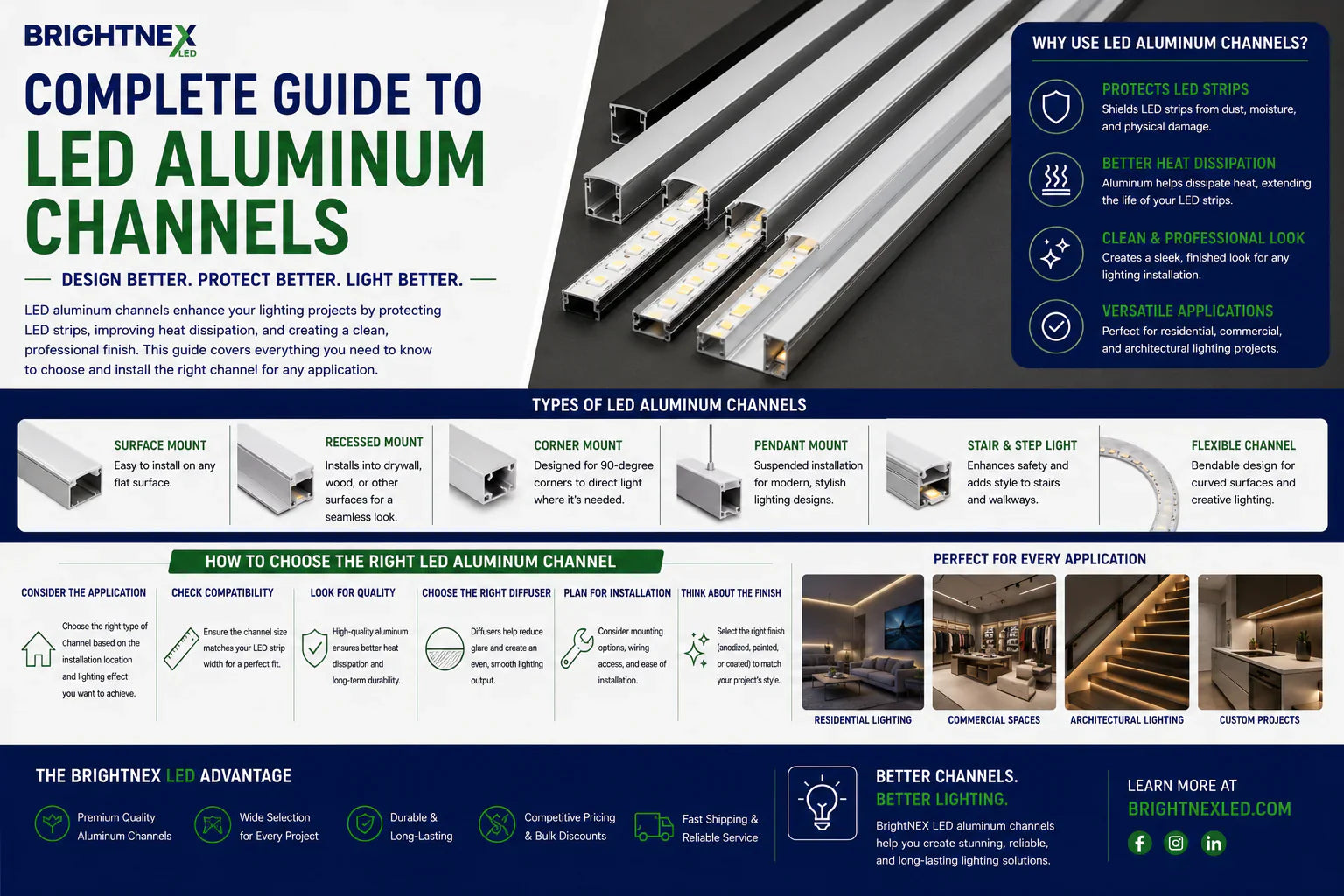
What LED aluminum channels actually do
An LED aluminum channel is a rigid profile that houses LED strip light and typically includes a diffuser lens, end caps, and mounting clips or a recessed flange. It gives the strip a straight, finished appearance while helping dissipate heat away from the PCB.
That heat function matters. Even high-quality strip lights perform better when thermal load is controlled. In practical terms, a proper aluminum profile can help preserve lumen output, color consistency, and long-term reliability. This is especially relevant on longer runs, higher-output tape, COB strip applications, and enclosed millwork details where heat can build up faster.
The second job is visual. A bare strip can expose diode spacing, adhesive irregularities, and wiring transitions. A channel with the right lens turns that raw light source into an architectural feature. In high-end homes, under-cabinet systems, closet lighting, toe-kick accents, and cove details, that finish quality is usually what the client notices first.
Types of LED aluminum channels
Not every profile is built for the same install condition. Choosing the right one depends on where the strip is going, how much output you need, and how refined the final appearance must be.
Surface-mounted channels
Surface-mounted profiles are the most common option. They install directly onto cabinets, shelving, walls, or millwork and work well when there is no routing or drywall recess available. They are fast to deploy and easy to service later.
For retail displays, under-cabinet runs, and utility applications, this profile is often the most efficient choice. The trade-off is visibility. Because the housing sits proud of the surface, it becomes part of the visual design, so finish and lens selection matter more.
Recessed channels
Recessed profiles are designed to sit flush inside routed wood, drywall reveals, or built-in niches. They create a cleaner, more integrated line of light and are a strong fit for luxury residential work.
They also demand more planning. The channel depth, flange width, and cutout dimensions need to match the job conditions exactly. If the recess is too shallow, the strip may sit too close to the lens and create dotting. If it is too deep, output can drop more than expected.
Corner channels
Corner profiles mount at an angle, usually 45 degrees, where two surfaces meet. They are often used under upper cabinets, inside display cases, or in shelving where you want to wash light across two planes instead of aiming it straight down.
These are useful when the installer needs both task light and visual softness. They can reduce glare compared with a flat-mounted strip, but layout still matters because angled light can reveal surface defects more easily.
Suspended and specialty channels
Suspended profiles, mud-in styles, and deeper architectural housings are used for more design-driven projects. They are common in commercial interiors, modern kitchens, and custom residential features where the profile itself becomes a lighting element.
These products offer more flexibility, but they also tighten the compatibility requirements. Output, driver sizing, dimming method, suspension hardware, and lens performance all need to be specified correctly.
How to size channels correctly
A common mistake is selecting the profile after choosing the strip. In professional installations, the better order is to confirm strip width, output, and application first, then match the channel.
Start with strip width. Many trade buyers work across multiple tape formats, including 6.5mm, 8mm, 10mm, and 12mm COB or specialty strips, plus RGB, RGBW, CCT, and IC RGB configurations. The internal width of the channel must comfortably fit the tape and any lead wire transition without pinching or forcing the strip.
Depth matters just as much. A shallow channel with a clear lens may still show LED points, especially with standard SMD strips. COB and SCOB strips reduce that issue because the light source is more continuous, but even then, lens distance affects the final look. If the goal is a smooth premium line of light, deeper profiles or higher-diffusion lenses are usually the safer choice.
Length is the next factor. Standard channel sections are often manageable for shipping and field handling, but long continuous visuals may require careful seam placement. On high-visibility jobs, every break line should be planned in advance, not left to the installer on site.
Lens options and when they matter
The diffuser is not just a cover. It changes output, glare, and finish quality.
Clear lenses preserve the most brightness but reveal diode pattern more easily. Frosted lenses soften the appearance and reduce glare, which makes them a popular choice for residential and hospitality work. Opal or higher-diffusion lenses create the smoothest line, though they can reduce visible output slightly.
That trade-off is worth evaluating project by project. If the application is toe-kick lighting, display shelving, or decorative cove light, diffusion usually matters more than maximum brightness. If the install is task lighting under cabinets or in a work area, you may want to preserve more output and choose the strip density accordingly.
Why heat management is a buying issue, not just an engineering issue
For wholesalers, contractors, and resellers, thermal control affects project cost. Better heat dissipation can support longer product life and reduce premature failures that lead to labor-heavy service calls.
This does not mean every strip needs a heavy-duty profile. Low-wattage accent runs in open air are less demanding than high-output task lighting, tightly enclosed cabinetry, or long architectural runs. But when projects move into premium residential spaces, clients expect consistency. A quality channel helps support that expectation because it protects both the light source and the finished appearance over time.
Complete guide to LED aluminum channels for installers
Field conditions decide whether a channel system performs well. The mounting surface must be clean, straight, and appropriate for both the tape adhesive and the profile hardware. If the profile is twisted, bowed, or loosely fixed, the lens fit and light line will show it.
Plan wire entry before mounting. This sounds basic, but it is one of the most common causes of rework. End-feed and bottom-feed approaches each have benefits depending on cabinet construction, recess depth, and access to the driver location.
Driver compatibility should also be resolved early. If the strip is part of a dimmable system using TRIAC, ELV, MLV, or 0-10V control, the complete assembly should be treated as one specification package. Trade buyers sourcing premium projects often prefer components that are already aligned for dry, damp, or wet location demands, especially when drivers include proper junction box solutions for code-friendly installation.
What buyers should look for when sourcing channels in volume
Consistency matters more than flashy specs. A reliable supplier should offer stable extrusion quality, lenses that fit correctly, repeatable finish tolerances, and packaging that protects long sections in transit.
Certifications and system compatibility also deserve attention. While the channel itself may not carry the same decision weight as the strip light or driver, professional buyers still need confidence that the full installation supports safety, code expectations, and dependable performance. That is one reason many contractors standardize around suppliers that already serve demanding residential and commercial jobs across the US market.
Price still matters, of course. But in wholesale purchasing, the cheapest profile is not always the lowest-cost choice. If poor lens fit, inconsistent anodizing, or weak accessories slow down crews and create punch-list issues, margin disappears fast.
Common mistakes to avoid
Most failures are not dramatic. They show up as light dots, loose lenses, misfit strips, or a finish that feels less refined than the project budget suggests. The usual causes are simple: choosing a profile too shallow for the strip, underestimating diffuser impact, failing to plan wire exits, or treating the channel as optional.
A better approach is to specify the channel as part of the lighting system from the start. On premium jobs, that mindset protects appearance, performance, and installation efficiency. Suppliers like BrightNex LED understand that trade buyers are not just purchasing parts. They are protecting project quality, labor time, and reputation.
The best aluminum channel is the one that fits the strip, the mounting condition, and the client expectation without forcing compromises in the field. Get that right, and the light looks intentional from day one and still looks right long after the job is closed.
FAQ
What are LED aluminum channels used for?
LED aluminum channels house LED strip lights, improve heat dissipation, protect the strip, and create a cleaner, more professional lighting appearance.
Do LED strip lights need aluminum channels?
While not always required, aluminum channels improve appearance, reduce visible hotspots, help manage heat, and extend the lifespan of many LED strip installations.
What is the difference between recessed and surface-mounted LED channels?
Recessed channels sit flush within cabinetry, drywall, or millwork, while surface-mounted channels attach directly to the surface and remain visible.
Which diffuser lens is best for LED channels?
Frosted and opal diffusers are popular because they reduce glare and create a smoother line of light. Clear lenses provide maximum brightness but reveal LED points more easily.
Can COB strip lights eliminate hotspot visibility in aluminum channels?
COB strip lights significantly reduce hotspot visibility thanks to their continuous light output, making them ideal for premium architectural lighting applications.