
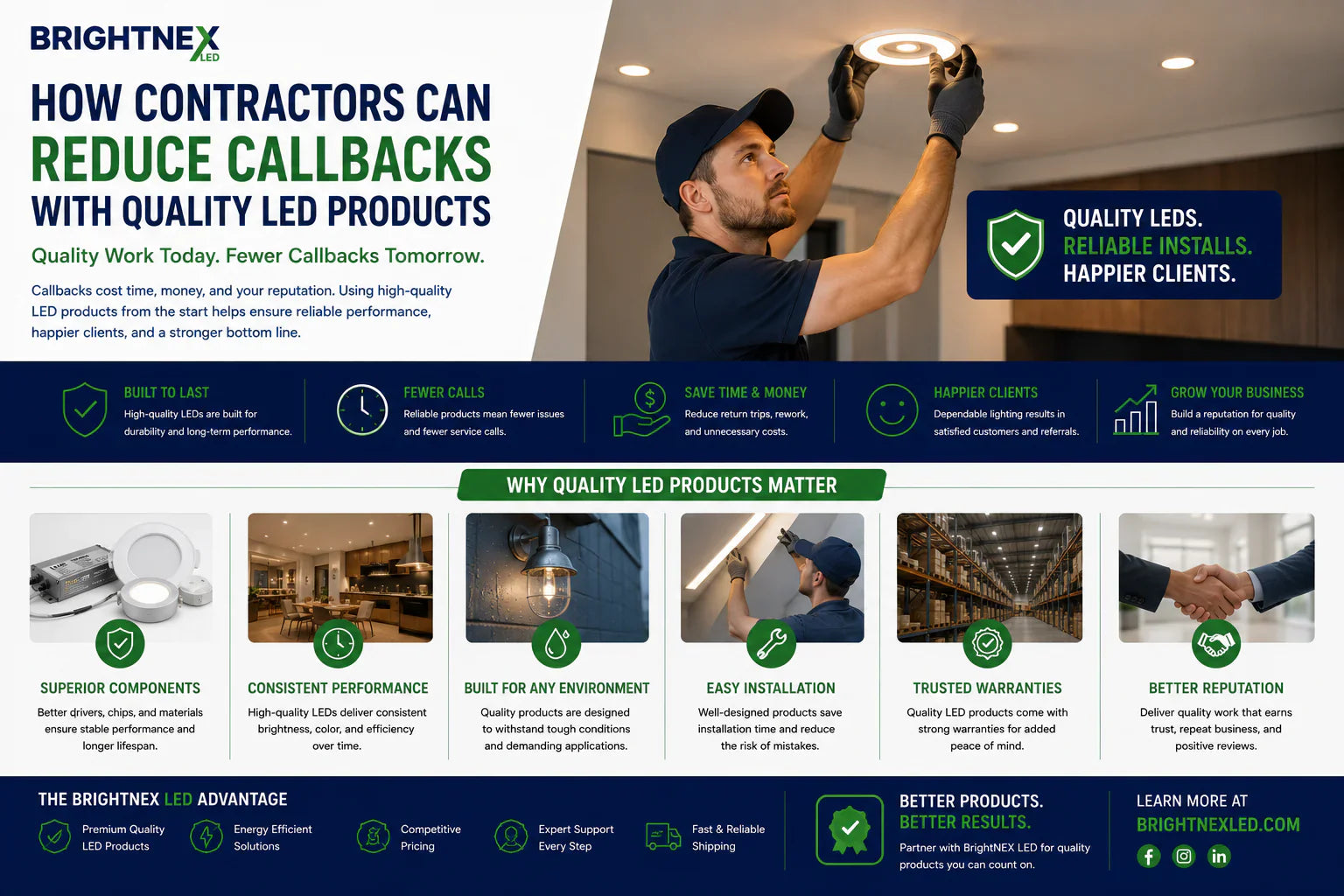
How contractors can reduce callbacks with quality LED products in real jobs
Reducing callbacks starts before installation. It begins with choosing products that are built for professional use, correctly certified, and designed to work together. In LED lighting, that means more than selecting a strip or fixture with the right color temperature. It means checking the full system - driver, dimming protocol, connectors, profiles, ratings, and load conditions.
A contractor who installs premium LED strips with a mismatched driver can still end up with flicker and customer complaints. A downlight with inconsistent trim quality can lead to visible finish issues in a luxury ceiling. A wet-location project using components not suited for the environment may pass on day one and fail months later. The field does not forgive weak compatibility.
That is why quality LED products matter. They reduce uncertainty. Better manufacturing consistency, tighter tolerances, verified certification, and dependable dimming performance all translate into fewer surprises after turnover.
Start with certification, not just price
If a product is going into a professional installation, certification should be part of the first review, not the last. UL-listed and properly labeled LED products help protect both the project and the contractor. They support inspection, reduce liability concerns, and signal that the product has been evaluated to recognized safety standards.
This matters even more on projects where strips, drivers, connectors, and accessories are combined into a custom system. If one part of that system is questionable, the whole installation becomes harder to stand behind. Contractors need products that can be installed with confidence across dry, damp, and wet location requirements, not products that create debate at inspection or uncertainty after closeout.
Price still matters, of course. Every trade buyer is protecting margin. But margin is not just unit cost. Margin is what remains after the job is complete and the crew is not sent back. The better calculation is total installed cost plus service risk.
Quality control shows up in the finish
A premium LED product often looks better on the wall, in the ceiling, or under the cabinet because its build quality is more consistent. COB and SCOB strip lights, for example, can help reduce visible dotting and create a cleaner line of light in luxury spaces. That may sound like a design issue, but it becomes a callback issue when the homeowner expected smooth illumination and got a segmented look instead.
High-end residential clients notice details. They will see uneven output, poor color consistency, or a dimming curve that feels abrupt. On these jobs, product quality directly affects client satisfaction.
Driver compatibility is where many callbacks begin
One of the fastest ways to create service calls is to treat the driver as an afterthought. In LED systems, the driver is not an accessory. It is a core performance component. If the dimmable driver is poorly matched to the load or control type, the result can be flicker, dropout, dead travel, noise, or shortened product life.
Contractors working across TRIAC, ELV, MLV, or 0-10V dimming environments already know that not all driver claims hold up equally in the field. This is where quality LED sourcing matters most. Drivers should be selected with verified compatibility, proper derating, and clear application ratings. Junction box design also matters, especially when installations need clean compliance for dry, damp, or wet locations.
When a supplier specializes in dimmable driver solutions and understands real-world compatibility, that removes friction from the job. It also reduces the guesswork that often leads to return visits. BrightNex LED focuses heavily on this category because driver performance is one of the biggest factors in long-term lighting stability.
The system has to be matched, not mixed blindly
A good strip paired with the wrong wire gauge, undersized power supply, or questionable connector can still fail. Contractors reduce callbacks when they buy systems, not isolated parts. That means matching strip width, voltage, wattage, controls, aluminum profiles, and accessories from the start.
This is especially relevant with modern strip lighting options like 6.5mm, 8mm, 10mm, and 12mm COB formats, along with RGB, RGBW, CCT, and IC RGB systems. These products offer flexibility and premium results, but only when all components are aligned. Mixing products from multiple sources may save a few dollars upfront, yet it often increases troubleshooting later.
Installation efficiency affects long-term reliability
Poor-quality products do not just fail more often. They also install less cleanly. Connectors fit inconsistently. Mounting accessories feel loose. Drivers take longer to wire. Product labeling is unclear. Each of those issues increases labor time and creates more opportunities for mistakes.
Reliable products help crews work faster and more accurately. Clear specs, predictable dimensions, and consistent electrical performance make installations more repeatable across multiple jobs. That matters for contractors scaling production, managing several crews, or supplying lighting packages to builders and remodelers.
In practice, the best products reduce both hard failures and soft failures. A hard failure is a dead driver or a non-working run. A soft failure is a result that technically works but does not meet the client's expectation for dimming, finish quality, color consistency, or application suitability. Both generate callbacks.
Application ratings are not optional details
Another common source of callbacks is using a product outside its intended environment. A driver or fixture that performs well in a conditioned indoor space may not be the right choice for a damp bathroom ceiling, exterior soffit, or other demanding location. The same applies to accessories and enclosures.
Contractors should verify not only voltage and output, but also environmental ratings, enclosure requirements, and thermal conditions. A product that is fine in theory can become unreliable when heat buildup, moisture exposure, or load stress is introduced. Quality suppliers make these distinctions clear, which helps buyers avoid field decisions that later become warranty conversations.
This is one reason premium products are often favored in luxury residential work. These homes include layered lighting, detailed millwork, specialty dimming systems, and spaces where visual defects are obvious. Better-rated, better-built products hold up more consistently under those expectations.
Wholesale buying strategy can lower callback risk
There is also a procurement side to this issue. Contractors who source from a focused wholesale supplier often reduce callbacks because they get better product consistency from job to job. When inventory changes constantly or equivalent substitutions are made without technical review, crews end up installing systems with different behaviors. That makes troubleshooting harder and client results less predictable.
A stable wholesale catalog matters. It allows contractors, electricians, and lighting retailers to standardize around proven components. Once a team knows which strip, driver, control, and profile combinations perform reliably, they can repeat that success across projects. Standardization is one of the most practical ways to reduce service calls over time.
Wholesale value is part of this equation too. Competitive trade pricing makes it easier to stay with dependable products rather than dropping down to lower-grade alternatives just to protect bid numbers. The right supplier helps contractors preserve both margin and field performance.
The best way to think about quality LED products
Quality LED products are not simply premium for the sake of premium. They are products chosen because they reduce risk. They improve installation speed, support cleaner inspections, perform more consistently with dimming systems, and deliver a finish quality that fits professional work.
That does not mean every project needs the highest-end option in every category. It depends on the application, the client's expectations, and the control environment. But on any job where callbacks hurt profitability or reputation, quality should be treated as a cost-control strategy, not a luxury.
The contractors who win repeat work are usually not the ones with the lowest material number. They are the ones whose lighting systems keep working, keep dimming correctly, and keep looking right after the job is handed over. If you want fewer return trips, fewer punch list complaints, and more confidence on every install, start by buying products that are built to stay off your callback schedule.
FAQ
How can contractors reduce LED lighting callbacks?
Contractors can reduce callbacks by using UL-listed products, matching drivers and dimmers correctly, selecting proper environmental ratings, and sourcing complete lighting systems from reliable suppliers.
What causes most LED lighting callbacks?
Common causes include dimming incompatibility, poor driver selection, voltage drop, low-quality connectors, environmental rating mismatches, and inconsistent product quality.
Why is driver compatibility important in LED installations?
The driver controls power delivery and dimming performance. An incompatible driver can cause flicker, buzzing, poor dimming, shortened lifespan, and customer complaints.
Do premium LED products really reduce service calls?
Yes. Higher-quality LED products typically offer better manufacturing consistency, stronger certification, improved dimming performance, and more reliable long-term operation.
Why do contractors choose UL-listed LED products?
UL-listed products support code compliance, improve safety confidence, simplify inspections, and help reduce liability and installation risks.