
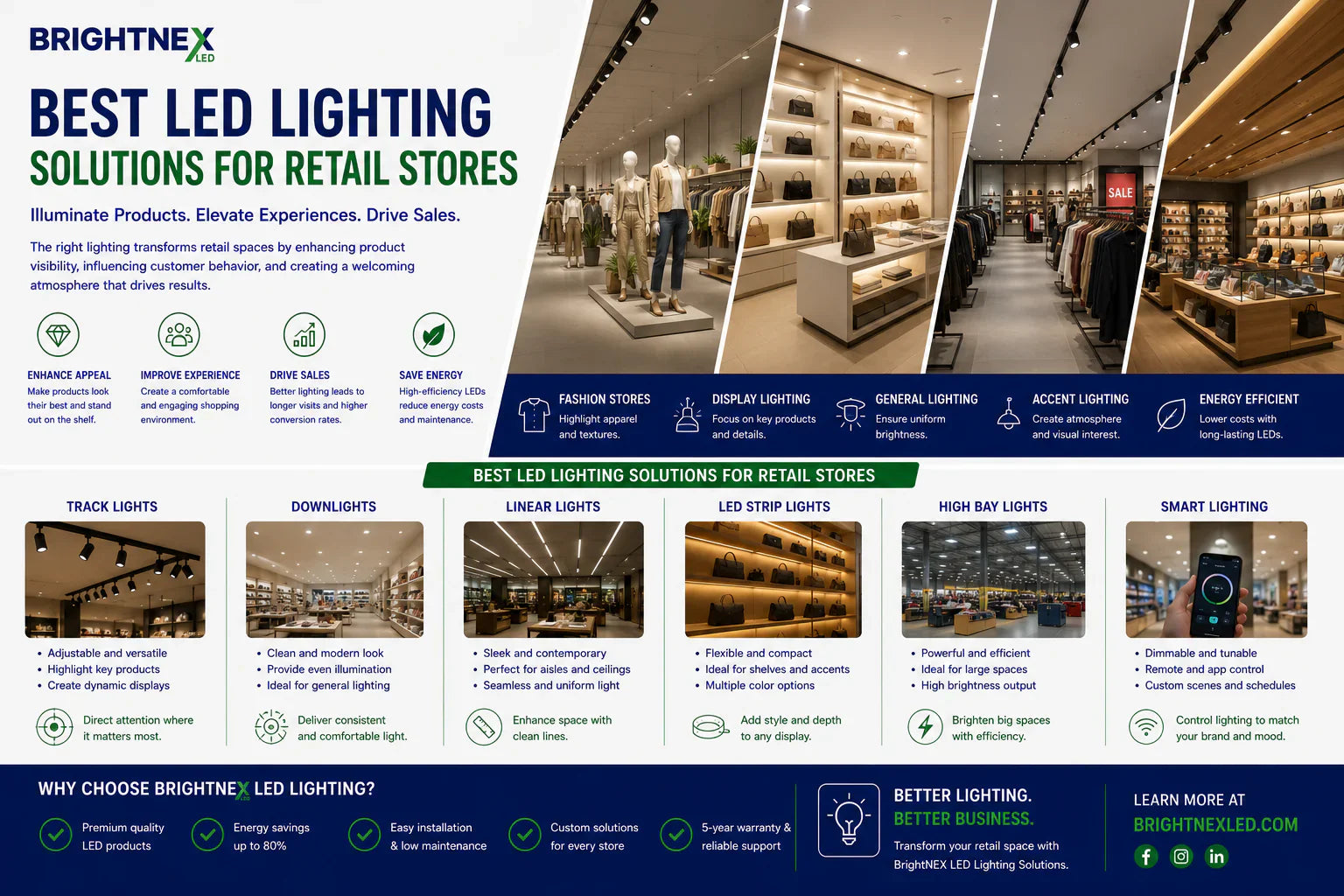
What the best LED lighting solutions for retail stores actually need to do
A retail store has competing priorities. Merchandise should look sharp and inviting, walkways need clear and even illumination, focal displays need contrast, and the overall environment has to feel intentional rather than harsh. If one layer is missing, the store either feels dull or overlit.
That is why a single fixture type rarely solves the whole job. Recessed downlights can carry the general lighting load, but they are not enough for shelving, display niches, under-counter accents, or perimeter details. LED strip systems fill those gaps with better precision. When paired with dimmable drivers and proper aluminum profiles, they create cleaner lines, better thermal management, and a more finished result.
For professional buyers, the stronger approach is layered lighting. Ambient light handles circulation and comfort. Accent light draws attention to products and feature walls. Task light supports cashier counters, fitting rooms, and service areas. Decorative light helps reinforce brand identity. The best retail projects balance all four without making the ceiling look crowded.
Recessed downlights for clean ambient coverage
Recessed downlights remain one of the most dependable LED lighting solutions for retail stores because they keep the ceiling clean and deliver broad, efficient illumination. They work especially well in boutiques, showrooms, beauty retail, convenience stores, and luxury-oriented spaces where visual clutter hurts the design.
The trade-off is beam control. If the spacing is off or the lumen package is too aggressive, glare becomes a problem fast. That is why professionals should look beyond wattage and focus on beam spread, trim quality, color temperature, and dimming compatibility. A warm-to-neutral white often works better than a cold white in retail because products and interior finishes read more naturally.
Downlights are strongest when used as the base layer, not the entire plan. They establish comfort and visibility, then other fixture types handle the visual selling points.
Where downlights work best
Sales floors, fitting rooms, checkout zones, and circulation paths are the obvious applications. In premium retail, they also work well in vestibules and transition areas where a polished ceiling appearance matters. If the project includes damp or mixed-environment zones, driver and housing selection becomes more important.
LED strip lighting for shelves, displays, and architectural details
If the goal is to make merchandise pop, LED strip lighting is often the better investment than adding more ceiling fixtures. Strip systems bring light closer to the product, reduce shadowing, and create a more upscale presentation on shelves, under cabinets, inside display cases, and along millwork.
COB and SCOB strip lights are especially effective in retail because they deliver a smooth, dot-free line of light. That matters in open shelving and reflective surfaces where standard diode spacing can cheapen the look. For stores that sell cosmetics, apparel, jewelry, home goods, or premium packaged products, the visual difference is easy to see.
Width options also matter during specification. Narrow formats such as 6.5 mm or 8 mm strips can fit into tighter channels and display applications, while 10 mm and 12 mm options may offer broader compatibility depending on power and output requirements. The right choice depends on profile size, run length, driver matching, and the finish level expected by the client.
Why aluminum profiles matter
Many strip failures are not caused by the LED tape itself. They come from poor heat management, weak mounting, or unfinished installation details. Aluminum profiles help solve all three. They improve heat dissipation, protect the strip, and give the install a straight architectural appearance that retail buyers notice immediately.
For contractors and store fixture suppliers, profiles also reduce callbacks. A properly housed strip system is easier to clean, better protected from impact, and more consistent across repeated locations.
Color temperature and tunability by retail type
There is no universal best color temperature for every store. Apparel and lifestyle retail often benefit from warm or warm-neutral tones that flatter materials and skin tones. Tech retail and modern display concepts may lean cooler for a crisp, contemporary feel. Grocery, specialty food, and wellness spaces usually require more careful tuning so products look fresh rather than washed out.
This is where CCT tunable strips and dimmable systems become valuable. They give designers and installers more flexibility during final aiming and commissioning. Instead of locking the project into one look too early, the lighting can be adjusted to suit merchandise, finishes, and time-of-day conditions.
RGB, RGBW, and IC RGB products also have a place, but only in the right concept. They work best for feature walls, seasonal displays, branded statement zones, and experiential retail. They should not replace the core white-light system. Used selectively, they add energy and differentiation. Overused, they make the store feel gimmicky.
Dimmable drivers and controls are not optional details
A retail lighting plan lives or dies by control quality. Even premium fixtures underperform when paired with mismatched or unstable drivers. Flicker, inconsistent dimming, and premature failures create problems that hurt the installer and the store operator.
The better approach is to specify dimmable LED drivers based on the control method already planned for the project. TRIAC, ELV, MLV, and 0-10V each have their place. What matters is matching the driver, load, and control hardware correctly. For multi-zone retail environments, this allows ambient, accent, and decorative layers to be adjusted independently.
Drivers with junction boxes add another practical advantage, especially for projects with wet, damp, or dry location needs across different areas. That simplifies procurement and helps standardize the install package. For wholesalers, electricians, and retailers buying in volume, consistency across drivers and accessories saves time in the field.
Safety, certification, and why UL still matters
For a trade buyer, certification is not a marketing extra. It is part of risk management. Retail projects need products that can stand up to inspection, operate dependably, and support long-term maintenance without creating uncertainty around safety.
UL-listed and properly marked LED strips, drivers, and related components give contractors and distributors more confidence during specification and installation. This is especially important in projects with exposed applications, public-facing interiors, or premium fit-outs where rework is expensive.
The same applies to connectors, wires, controllers, and transformers. A retail system is only as reliable as its weakest component. Saving a little on accessories often costs more later through troubleshooting, downtime, or replacement labor.
Choosing the best setup for different retail formats
Small boutiques usually benefit from a simple layered plan - recessed downlights for general lighting, COB strip lighting for shelving and under-display accents, and dimming control for day-to-evening adjustments. This creates a polished look without overbuilding the system.
Larger chain stores and rollout programs need repeatability. That favors standardized downlights, consistent strip widths, dependable drivers, and accessories that reduce variation from one location to another. Wholesale buyers should prioritize SKU discipline and technical compatibility as much as fixture appearance.
Luxury retail demands the highest finish quality. In these projects, dot-free strip light, premium aluminum channels, stable dimming, and careful color consistency are worth paying for. The customer may never ask what driver is above the ceiling, but they will notice when the merchandise looks expensive and the environment feels refined. That is why professional buyers across the US continue to spec higher-grade systems, especially in design-sensitive markets such as Los Angeles, where premium presentation is part of the sale.
BrightNex LED serves this side of the market well because the catalog is built for professional buyers who need certified products, dimmable driver options, strip-lighting depth, and wholesale pricing that protects margins.
What to look for before you place a wholesale order
The smartest retail lighting buys are not based on fixture type alone. Buyers should confirm certification status, strip width, output level, dimming method, installation environment, run length, profile fit, and accessory compatibility before finalizing a project package. That sounds basic, but it is where many ordering mistakes happen.
If the project includes millwork, shelving, display cases, recessed channels, and open-ceiling zones, coordination matters early. The lighting package should support the architectural details, not force field modifications later. That is where a focused wholesale supplier becomes more useful than a broad catalog with too many mixed-quality options.
Retail lighting should help products sell, help crews install faster, and help owners avoid service issues down the road. If the plan does all three, you are not just buying fixtures. You are building a better store experience with fewer compromises.
FAQ
What are the best LED lighting solutions for retail stores?
The best retail lighting solutions combine recessed LED downlights for ambient lighting, COB LED strip lights for shelving and displays, dimmable drivers, and layered lighting controls for flexibility and product presentation.
Why are COB LED strips popular in retail stores?
COB LED strips create a smooth, dot-free line of light that enhances product displays, shelving, display cases, and architectural details while delivering a premium appearance.
What color temperature is best for retail lighting?
It depends on the store type. Apparel and lifestyle stores often use warm-neutral lighting, while technology and modern retail concepts may benefit from cooler color temperatures.
Should retail lighting be dimmable?
Yes. Dimmable lighting allows retailers to adjust brightness levels for different times of day, merchandise displays, promotions, and customer experiences.
Why is UL certification important for retail LED lighting?
UL-listed lighting products help support safety, code compliance, inspection approval, and long-term reliability in commercial retail environments.