
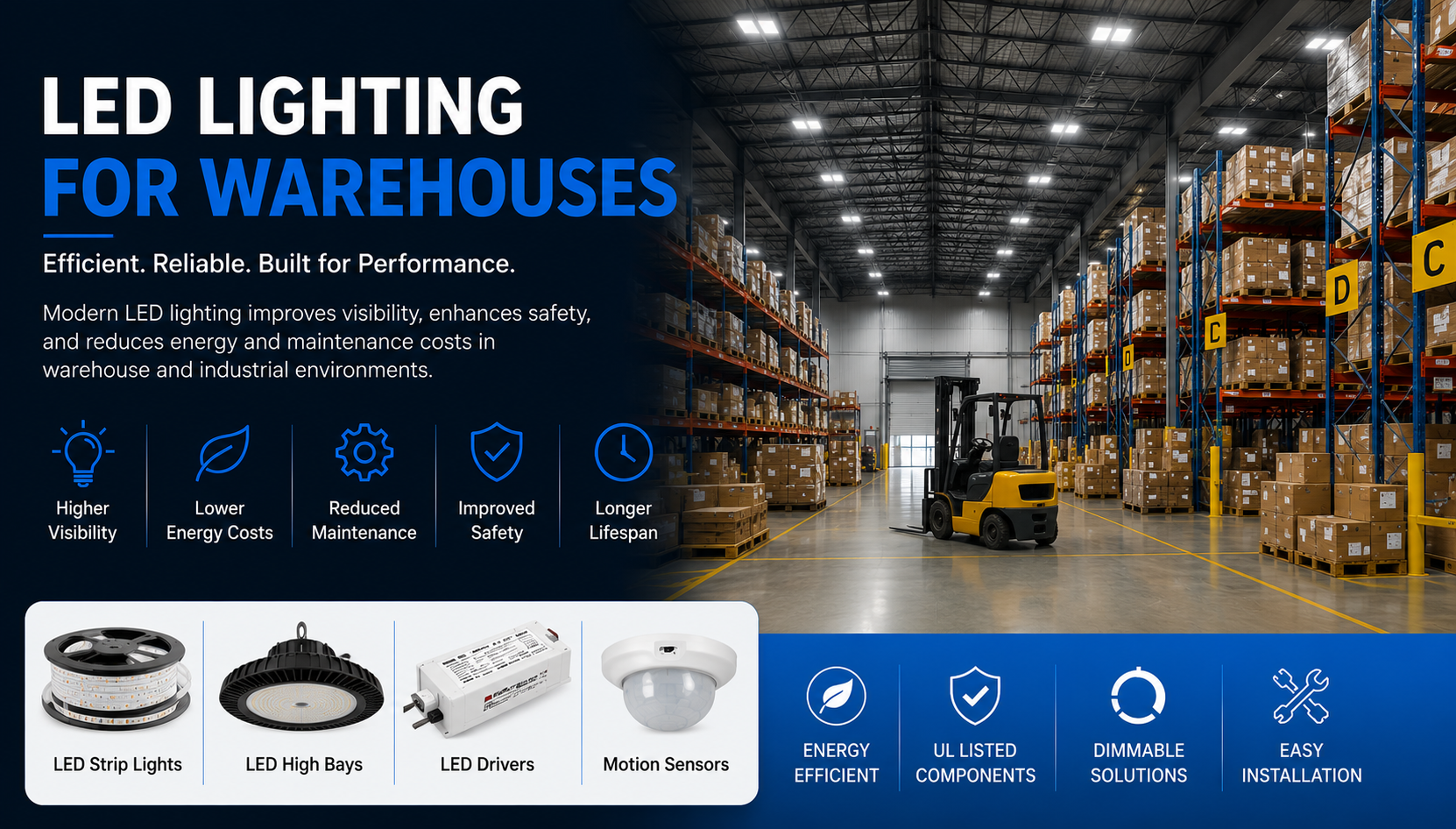
Warehouse lighting plays a critical role in daily operations. From inventory management and order fulfillment to equipment operation and employee safety, proper illumination helps businesses work more efficiently while reducing operational costs.
Many warehouses still rely on outdated fluorescent or metal halide fixtures that consume excessive electricity, require frequent maintenance, and produce inconsistent lighting. Modern LED lighting offers a smarter solution by delivering brighter, more uniform illumination with significantly lower energy consumption.
Whether you're designing a new warehouse, upgrading an existing facility, or specifying lighting for an industrial project, choosing the right LED products can improve productivity, enhance safety, and provide long-term cost savings.
This guide explains the benefits of LED warehouse lighting and how contractors, facility managers, and business owners can select the right components for reliable, energy-efficient performance.
Why Warehouses Are Switching to LED Lighting
Industrial facilities often operate lighting systems for 10 to 24 hours a day. Because lighting accounts for a significant portion of electricity usage, improving efficiency can dramatically reduce operating expenses.
LED lighting offers several advantages over traditional technologies:
- Lower energy consumption
- Higher light output
- Longer operating life
- Reduced maintenance costs
- Instant full brightness
- Minimal heat generation
- Improved visibility
- Better color rendering
- Environmentally friendly operation
These benefits make LED lighting an excellent investment for warehouses of all sizes.
Improve Workplace Safety
Safety is one of the most important reasons to upgrade warehouse lighting.
Poorly lit aisles, loading docks, and storage areas increase the risk of accidents involving forklifts, pallets, and personnel.
Proper LED lighting helps improve:
- Visibility throughout the facility
- Identification of hazards
- Forklift navigation
- Reading shipping labels
- Product picking accuracy
- Emergency evacuation routes
A brighter work environment contributes to a safer and more productive warehouse.
Choose the Right Color Temperature
Selecting the proper color temperature improves both comfort and visibility.
General recommendations include:
- 4000K: Warehouses with mixed storage and packaging operations.
- 5000K: Distribution centers, logistics facilities, and high-activity workspaces requiring maximum visibility.
- 5700K–6500K: Specialized industrial applications where identifying fine details is critical.
Cooler white light often improves contrast, making it easier to identify products, labels, and inventory locations.
LED Strip Lighting for Specialized Applications
While general warehouse lighting is typically provided by high-output fixtures, LED strip lighting is ideal for task-specific areas.
Common applications include:
- Shelving illumination
- Storage racks
- Workbenches
- Inspection stations
- Display cabinets
- Stairways
- Equipment rooms
- Control panels
- Signage
- Emergency pathways
COB LED strips provide continuous, dot-free illumination, creating a clean and professional appearance in workspaces.
Reliable LED Drivers Are Essential
Every low-voltage LED system depends on a reliable LED driver.
A quality driver ensures:
- Stable voltage output
- Consistent brightness
- Flicker-free operation
- Overload protection
- Short-circuit protection
- Long operating life
Contractors should always match the driver's voltage and wattage to the lighting system while leaving approximately 20% reserve capacity for long-term reliability.
Use Smart Lighting Controls
Smart lighting can further reduce warehouse operating costs.
Popular control options include:
- Motion sensors
- Occupancy sensors
- Daylight harvesting
- Timers
- Multi-zone lighting
- Wireless controllers
- Automated scheduling
These systems ensure lights operate only when and where they are needed, reducing unnecessary energy usage.
Lower Maintenance Costs
Replacing lamps in warehouses can be challenging due to high ceilings and specialized lifting equipment.
Because LED products have significantly longer lifespans than fluorescent or HID fixtures, maintenance intervals are greatly reduced.
Benefits include:
- Fewer lamp replacements
- Lower labor costs
- Less equipment downtime
- Reduced disruption to warehouse operations
For facilities operating around the clock, this translates into substantial long-term savings.
Plan Lighting by Warehouse Zone
Different warehouse areas require different lighting strategies.
Storage Aisles
Provide uniform illumination to improve product identification and forklift visibility.
Loading Docks
Use bright, reliable lighting that supports safe loading and unloading at all hours.
Packing Stations
Install focused task lighting for accurate labeling, packaging, and quality control.
Maintenance Areas
Use high-quality lighting that allows technicians to safely inspect and repair equipment.
Office Areas
Combine ambient lighting with task lighting to create comfortable administrative workspaces.
Energy Efficiency and Sustainability
Modern LED systems consume significantly less electricity than traditional warehouse lighting.
Additional environmental benefits include:
- Lower carbon emissions
- Reduced cooling loads due to less heat generation
- Longer product lifespan
- Fewer replacement materials entering the waste stream
Many companies also benefit from utility rebate programs when upgrading to energy-efficient lighting.
Choose Certified Components
Industrial lighting projects should always use certified electrical products.
UL Listed LED drivers, LED strips, controllers, and related accessories provide greater confidence in:
- Electrical safety
- Product reliability
- Consistent performance
- Compliance with project specifications
Using certified products helps contractors deliver installations that meet industry standards.
Why Contractors Choose Commercial LED Solutions
Professional contractors prefer commercial-grade LED products because they offer dependable performance in demanding industrial environments.
Quality components provide:
- Stable operation
- Excellent thermal management
- Long service life
- Reliable power delivery
- Easy installation
- Reduced service calls
Using premium lighting products improves both customer satisfaction and long-term project value.
Conclusion
LED lighting has become the preferred solution for modern warehouses because it delivers superior visibility, lower energy consumption, reduced maintenance, and improved workplace safety.
By selecting high-quality LED drivers, LED strip lights for task areas, smart lighting controls, and certified components, contractors and facility managers can create efficient warehouse lighting systems that support productivity while minimizing operating costs.
Whether you're upgrading a distribution center, manufacturing facility, storage warehouse, or logistics hub, investing in professional LED lighting is a smart decision that provides long-lasting performance and measurable savings.
Frequently Asked Questions
What is the best color temperature for warehouse lighting?
5000K is commonly recommended because it provides bright, daylight-like illumination that improves visibility and safety.
Can LED lighting reduce warehouse energy costs?
Yes. LED lighting uses significantly less electricity than fluorescent or metal halide fixtures and can greatly reduce operating expenses.
Are LED strips used in warehouses?
Yes. LED strips are commonly used for shelving, workstations, inspection areas, equipment rooms, and task lighting applications.
Why are quality LED drivers important?
A reliable LED driver provides stable power, prevents flickering, protects connected lighting, and extends the lifespan of the entire system.
Should warehouse lighting use UL Listed components?
Yes. UL Listed products are tested for safety and reliability, making them an excellent choice for industrial and commercial installations.