
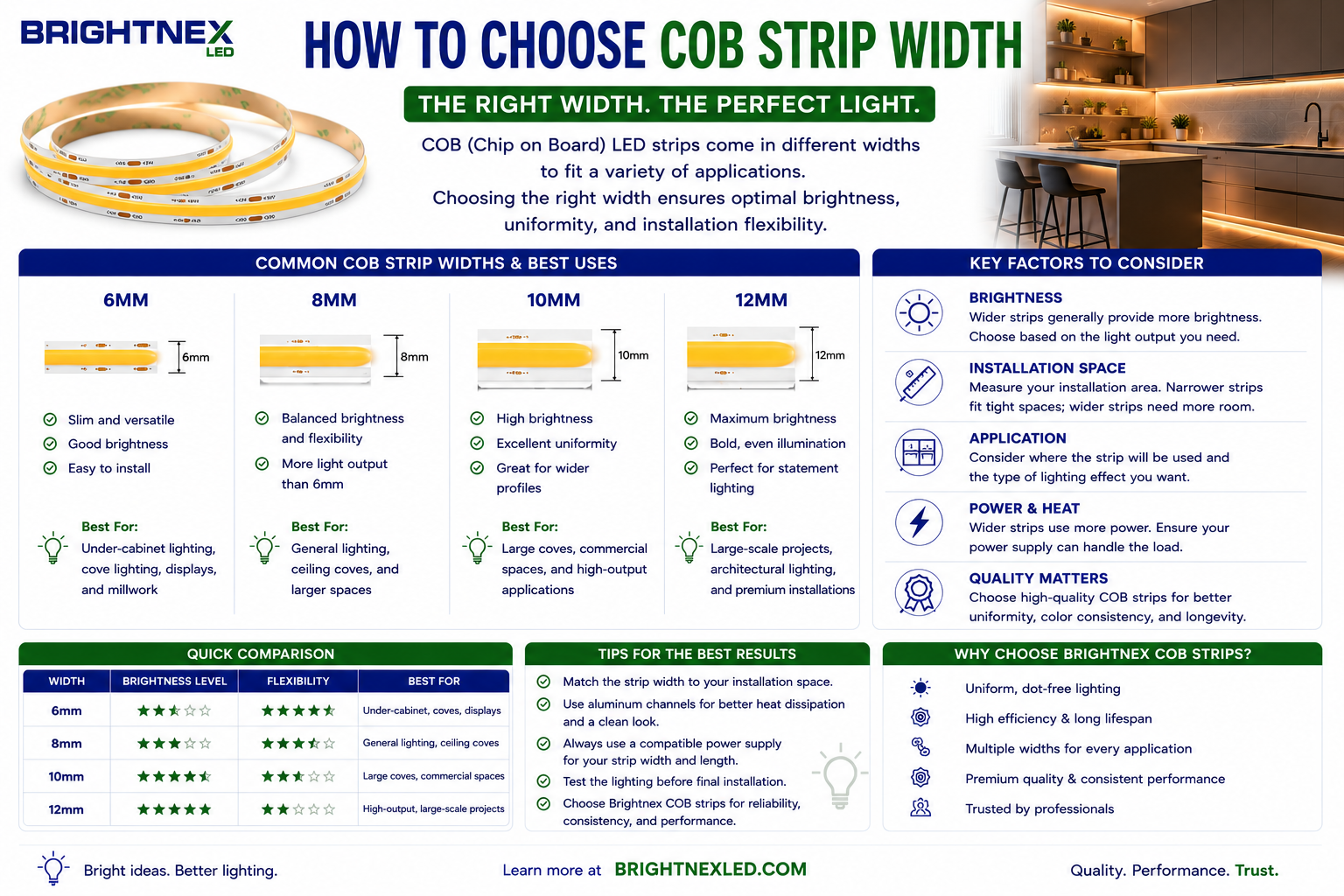
A COB strip that looks perfect on the spec sheet can still slow down an install if the width is wrong. The question of how to choose COB strip width usually comes up when the aluminum profile is already selected, the corners are tight, or the driver and connector plan leaves very little room for error. Width affects fit, handling, light output options, and how clean the finished job looks.
For trade buyers, this is not a cosmetic detail. Strip width changes what channels you can use, which connectors fit, how easy the run is to dress, and whether the product matches the demands of a luxury residential install or a higher-volume commercial package. If you are sourcing for electricians, lighting stores, or project supply, choosing the correct width early protects labor time and margin.
How to choose COB strip width without guessing
The fastest way to make the right call is to start with the physical constraints of the installation, then work backward to light performance and controls. In most projects, the strip does not choose the channel - the channel, recess, cabinet detail, millwork slot, or fixture body already sets the limit.
If the job has a narrow aluminum profile, a shallow reveal, or a small architectural recess, a 6.5mm or 8mm COB strip may be the practical choice. These widths help in tight details where every millimeter matters. They are often the safer option for slim under-cabinet channels, narrow mud-in applications, or decorative reveals where the goal is a refined line of light without fighting the housing.
If the installation has more room and the project needs stronger output, broader color options, or more installation tolerance, 10mm and 12mm strips are often the better fit. Wider strips commonly give you more flexibility for higher-performance builds, including RGB, RGBW, CCT, and IC RGB versions where extra circuit space matters.
That is why width should be chosen as part of a system, not as an isolated spec.
Start with the channel, profile, or mounting surface
On professional jobs, the first checkpoint is simple: what will the strip sit inside or attach to?
If the strip is going into an aluminum profile, check the internal width of the channel, not just the outside product dimensions. A nominal profile can still have a tighter usable interior once the diffuser and mounting base are factored in. You want enough room for the strip to sit flat without pinching, lifting at the edges, or bunching during installation.
A very narrow strip in a wide channel can work, but it may not always be ideal. You may lose some installation stability, especially on vertical runs or long field cuts. A strip that better matches the channel width usually gives a cleaner, more secure fit.
For direct surface mounting, width still matters because it affects visual proportion. In a high-end home, exposed linear lighting details need to look intentional. A strip that is too wide for a slim shelf reveal or toe-kick detail can make the line of light feel heavy. Too narrow, and it may look underbuilt for the scale of the application.
Width affects bending and routing in real-world installs
Not every job is a long, straight run. Millwork, niches, vanities, shelves, and custom ceilings often force the strip through turns, offsets, or narrow feeding points.
Narrower COB strips are generally easier to route through tighter spaces. A 6.5mm or 8mm strip can be easier to handle where the wiring path is restricted or where the installer needs more flexibility during placement. That does not mean wider strips are difficult, but they do ask for more room and more planning around transitions.
This matters even more when using connectors, corner solutions, or feed-through holes. A strip might fit the visible channel perfectly, then become a problem where it has to pass into a junction area or terminate in a compact housing. Width decisions should account for the entire run, not just the illuminated section.
How to choose COB strip width based on output and features
Once the physical fit is confirmed, move to performance. In many product lines, wider strips support more advanced configurations or higher-density circuit layouts. That can matter for buyers who need specific color control, wattage ranges, or signal complexity.
For example, single-color COB applications in straight architectural lines may fit well on narrower widths if the profile allows it. But when the job calls for RGB, RGBW, tunable white, or IC RGB, the available strip widths may narrow because those products need room for additional circuitry and solder points.
This is one reason 10mm and 12mm widths are common in more feature-rich systems. They give the product enough physical space to support more complex lighting functions while staying reliable in field conditions.
There is also a practical power conversation behind width. A wider strip does not automatically mean higher brightness, but many higher-output or more technically complex products are built on wider boards. If the project needs strong illumination in luxury coves, statement shelving, or premium task lighting, the width options available may naturally shift upward.
Match strip width to connectors, controls, and driver planning
Installers do not buy strip width just for the strip. They buy into a full system that includes connectors, wire leads, controllers, and dimmable drivers.
This is where mismatches create callbacks. If the strip width does not align with the intended connector family, field termination becomes slower and less reliable. A strip that technically works with a profile but does not match the accessories in your package can cost more in labor than it saves in material.
The same goes for control systems. RGB, RGBW, CCT, and addressable products all involve more than board width, but width often tracks with the complexity of the configuration. Before you commit, make sure the strip width you choose is available in the exact voltage, control type, and dimming approach the project requires.
For professional buyers, this is especially important on jobs using UL-listed components throughout the system. Consistency across strip, driver, control gear, and installation accessories keeps the package cleaner and easier to approve.
Common width choices and where they make sense
A 6.5mm COB strip is usually the answer when space is tight and the design detail is very slim. It is useful for narrow channels, compact display work, and refined architectural lines where the strip needs to disappear into the construction.
An 8mm strip often works as the middle ground for projects that still need a relatively narrow footprint but want more standard handling and broader compatibility with profiles and accessories.
A 10mm strip is one of the most versatile choices for trade work. It often balances installation ease, profile compatibility, and access to stronger performance options. For many contractors and resellers, this width covers a large share of everyday architectural and residential jobs.
A 12mm strip is commonly selected when the system needs added circuit capacity, broader feature support, or a more substantial build. It can be the better option for advanced color-changing applications and premium installations where performance and compatibility matter more than conserving a few millimeters.
Avoid the two most common buying mistakes
The first mistake is choosing width only by what fits today. If you select the narrowest possible strip just to satisfy a profile dimension, you can limit your options for connectors, output, or color control later. A little more width can make the rest of the system easier.
The second mistake is choosing width only by performance assumptions. Bigger is not always better. If the channel is tight, the reveal is delicate, or the routing path is restrictive, a wider strip can turn a clean install into a field adjustment problem.
The right answer is the one that fits the housing, supports the controls, and installs cleanly with the accessories you actually plan to use.
For wholesale buyers, it helps to stock widths with clear use cases instead of treating them as interchangeable. Narrow widths serve precision applications. Mid-width strips cover the broadest day-to-day demand. Wider formats support more specialized or feature-heavy packages. That approach makes quoting faster and reduces substitution issues once the job is underway.
If you are deciding between two widths, choose the one that gives your installer enough room to work while still meeting the design intent. A cleaner install usually wins over a theoretical spec advantage. On professional projects, the best COB strip width is the one that fits the system the first time.