
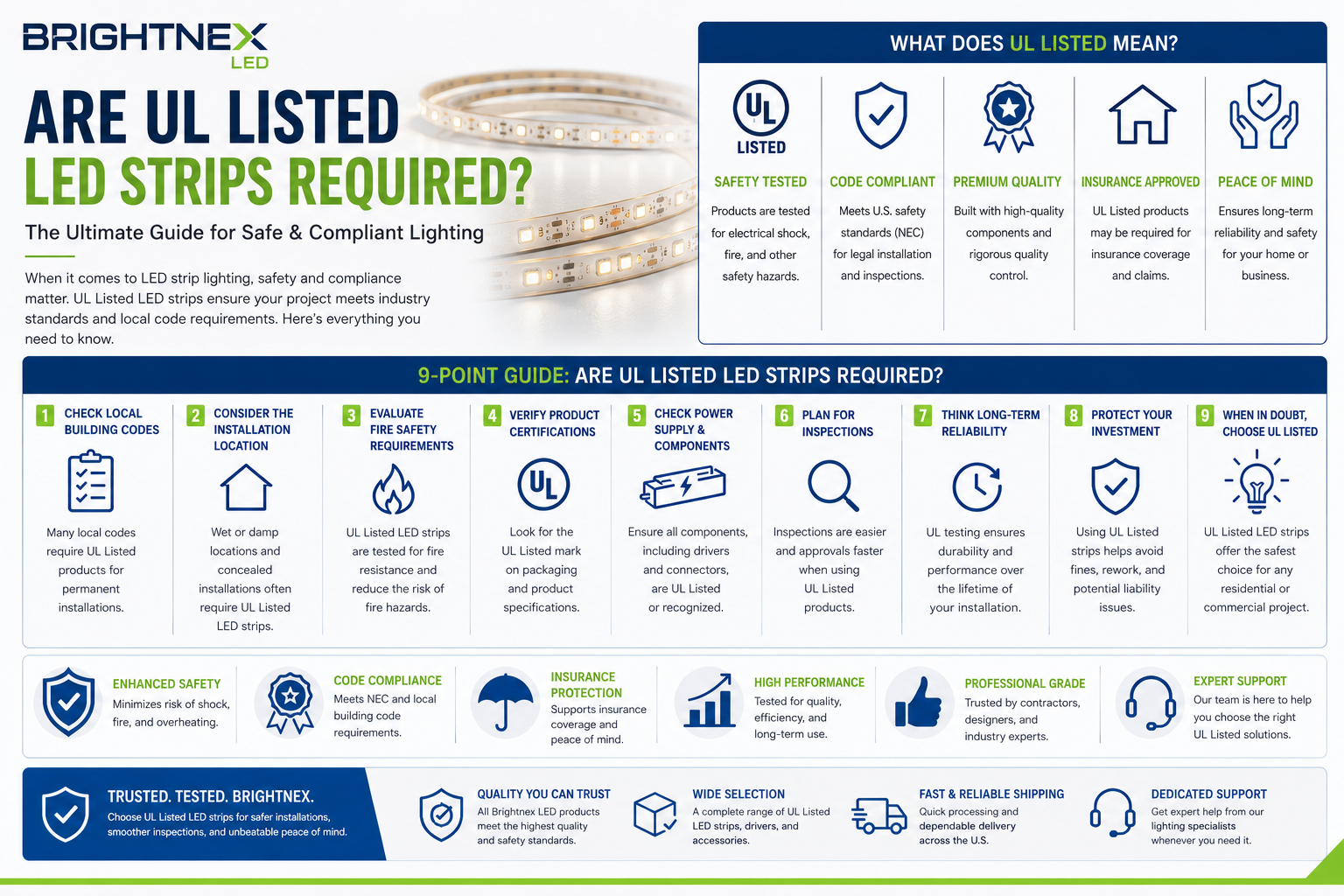
A failed inspection usually does not start with light output. It starts when the inspector asks for the cut sheet, the driver listing, or the marking on the strip itself. That is why contractors and lighting buyers keep asking: are UL listed strips required? The short answer is that it depends on the installation, the authority having jurisdiction, and whether the strip system is being used as a permanent part of the building.
For professional work, especially in residential remodels, custom millwork, hospitality, and luxury homes, treating UL listing as optional is a risk. If you are bidding serious projects, you want strip lighting that is easier to approve, easier to specify, and easier to defend when questions come up from inspectors, builders, or clients.
Are UL listed strips required by code?
Not every LED strip installation is addressed the same way, and that is where confusion starts. The National Electrical Code does not simply say all LED strip lights must be UL listed in every situation. What it does require is that electrical equipment used in installations covered by the code be listed, labeled, or otherwise approved where that listing is required by the product category, the application, or the local authority.
In practical terms, permanent architectural lighting is where UL listing matters most. If the strip is being installed inside cabinetry, under counters, in coves, toe kicks, wall details, or other built-in applications, inspectors and specifiers commonly expect a listed product. The same goes for systems installed in damp or wet locations, or anywhere the strip and driver become part of the building's electrical system rather than a temporary decorative accessory.
That is why experienced electricians usually do not ask whether they can get away without UL. They ask whether the strip, power supply, connectors, and wiring method will pass inspection as a complete system.
What inspectors usually care about
Inspectors are rarely focused on one sticker alone. They want to see that the lighting system is suitable for the application and installed according to its listing. That often means looking at the strip light, the driver, the low-voltage side, the enclosure, and the location rating.
If a strip is in a dry cove but fed by an unlisted driver with questionable splices, the job can still get flagged. If a listed strip is installed in a shower niche without the right wet-location rating, the listing alone does not solve the problem. Approval depends on the complete installation, not just one component.
When UL-listed LED strips are effectively required
There are a few situations where the answer to are UL listed strips required is functionally yes, even if the code language is not written in that exact plain-English form.
The first is any project subject to inspection. New construction, permitted remodels, tenant improvements, and many commercial jobs fall into this category. If the lighting is part of the permitted electrical scope, unlisted strip products can create delays, replacement costs, and arguments no contractor wants on a closeout schedule.
The second is specification-driven work. Designers, builders, and purchasing teams for upscale residential projects often require UL-listed products before the material is even approved for submittal. In high-end homes, nobody wants a callback because hidden linear lighting failed early or raised a safety concern after drywall and cabinetry were already finished.
The third is liability-sensitive work. Hospitality, multifamily, retail, and public-facing spaces tend to be less forgiving. Even if a cheaper off-brand strip could physically light the space, the risk profile is different when a project owner expects documented compliance and traceable product standards.
Luxury residential work raises the standard
In premium residential environments, listed product matters for more than inspection. It supports the value of the entire installation. A clean mud-in profile, warm dim performance, and even illumination lose their appeal quickly if the electrical components behind the finish are questionable.
That is one reason professionally sourced strip systems are common in high-end Los Angeles homes and other design-heavy markets. Builders and electricians want products with clear markings, compatible dimmable drivers, and ratings that align with dry, damp, or wet locations. It protects the project and protects the installer.
When people think UL is not required
The confusion usually comes from consumer-grade products. Plug-in LED tape sold for temporary accent lighting, holiday decor, or furniture add-ons may not be handled the same way as hardwired strip lighting used in a permanent install. Some low-risk, portable applications fall outside what contractors typically deal with on code-driven projects.
But trade buyers should be careful with that distinction. A product marketed online for simple stick-on use is not automatically appropriate for built-in residential or commercial work. Once the strip is integrated into cabinetry, millwork, ceilings, or other permanent elements, the standards get tighter and the tolerance for undocumented products drops fast.
There is also a difference between a product having some certification somewhere in the chain and the installed system being properly listed for the intended use. A reel of LEDs might reference recognized components, but that does not always mean the finished strip assembly is listed as an installable product.
UL listing is not the whole story
A listed strip is a strong starting point, but professionals know the job does not end there. Driver selection matters just as much. The wattage load, dimming protocol, enclosure style, and location rating all have to match the application.
For example, a TRIAC dimmable strip system in a dry residential cove has different requirements than a 0-10V run in a commercial setting. A wet-location application may need a driver with the right junction box and environmental rating, not just a listed strip. Connector quality, voltage drop planning, and aluminum profile heat management also matter for real-world performance.
This is where cheaper materials cost more. If one component in the chain is weak, the entire job can suffer from flicker, premature failure, or inspection issues. Wholesale buyers who source for repeat work usually care less about the lowest reel price and more about getting a system that installs cleanly and stays trouble-free.
How to buy strip lighting that will not create problems
For trade purchasing, the best approach is simple: buy strip systems as if every project may be reviewed by an inspector, builder, or owner representative. That means confirming the strip carries the proper listing mark, checking the driver certification, matching dimming type, and verifying whether the product is rated for dry, damp, or wet conditions.
It also means paying attention to documentation. A serious supplier should be able to provide clear specifications, not vague claims. If the reel says UL but the driver paperwork is missing, or the connectors are not suited to the system, you do not really have a complete professional solution.
For contractors and lighting resellers, consistency matters too. Standardizing around listed strip platforms reduces field confusion and purchasing mistakes. It helps crews know which 8 mm, 10 mm, 6.5 mm, or 12 mm strip families match which profiles, controllers, and drivers. That saves labor, and labor is where bad sourcing gets expensive.
The real cost of using non-listed strips
The cheapest strip on paper can become the most expensive strip on the job. If an inspector rejects it, you pay twice. If a cabinet installer has to remove trim for replacement, you pay more. If a homeowner in a luxury property sees uneven color shift or hears that the installed lighting lacks proper certification, your reputation takes the hit.
On high-visibility work, the safer play is to use listed products from the start. That is especially true when the lighting is concealed behind expensive finishes or tied into dimming systems that need predictable performance. BrightNex LED serves this market with UL-marked strip lighting and compatible drivers because professionals do not need guesswork in the field.
So, are UL listed strips required?
For temporary consumer use, maybe not always. For professional, permanent, inspected, or specification-grade installations, they are often expected and in many cases practically necessary. Even when the code language leaves room for interpretation, the jobsite reality usually does not.
If you supply or install LED strip lighting for serious projects, the better question is not whether you can avoid UL listing. It is whether you want to carry the risk of working without it. On professional jobs, safer approvals, cleaner documentation, and stronger client confidence are usually worth far more than the few dollars saved on uncertified material.
The smart move is to source strip lighting the same way you build the rest of the project - with components that are ready for inspection, ready for specification, and ready to stay in place long after the walls are closed.