
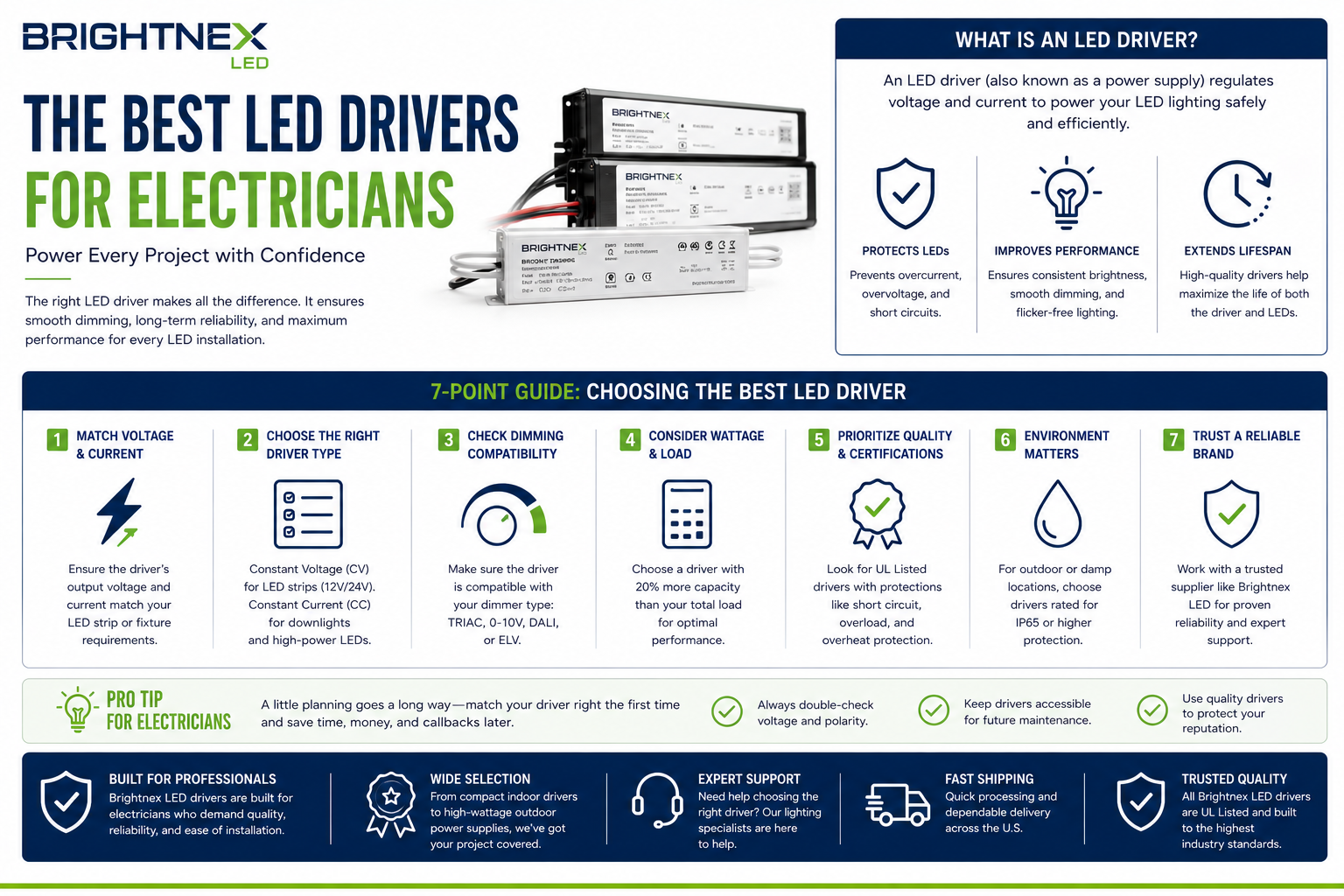
A callback for flicker, dropout, or dimming noise usually traces back to one component: the driver. That is why choosing the best LED drivers for electricians is less about chasing a brand name and more about matching the driver to the load, control type, location rating, and job conditions from the start. On residential and commercial projects alike, the right driver protects labor, keeps inspections moving, and prevents expensive troubleshooting after trim-out.
Electricians do not need marketing claims. They need drivers that wire cleanly, dim correctly, carry the right certifications, and hold up in the field. If you are sourcing for custom homes, retail lighting, hospitality spaces, or large strip light runs, the best choice depends on how the system will actually be installed.
What makes the best LED drivers for electricians
The first filter is certification. A driver with proper UL listing is not a small detail. It affects inspection confidence, jobsite acceptance, and long-term liability. For trade buyers, that alone narrows the field quickly.
The next filter is compatibility. A premium LED strip or downlight can still perform poorly if the driver is mismatched to the dimmer, underloaded, overloaded, or installed in the wrong environment. Good drivers are not just electrically correct on paper. They are predictable in real installations.
A strong driver for professional use usually checks five boxes. It offers stable output, supports the intended dimming protocol, fits the environmental rating of the project, includes practical installation features such as junction boxes, and gives enough headroom for the connected load. If one of those is missing, the install may still turn on, but it may not perform the way the client expects.
Start with the dimming method, not the wattage
A lot of driver issues begin when wattage gets all the attention and dimming gets treated as secondary. In the field, dimming compatibility is often the deciding factor between a smooth handoff and a return visit.
TRIAC and ELV drivers
For many residential applications, especially remodels and luxury homes with familiar wall-box controls, TRIAC or ELV dimmable drivers are the practical choice. They work well when the customer wants traditional wall dimming and the lighting design calls for tape light, under-cabinet runs, toe-kick illumination, or cove lighting.
That said, TRIAC is not automatically the best answer for every project. It depends on the dimmer model, the minimum load, and the driver's own dimming curve. ELV often performs better in higher-end dimming environments, especially where low-end smoothness and reduced buzz matter. If the project is design-driven and the owner will notice every flicker, driver quality matters more than shaving a few dollars off the line item.
0-10V drivers
On commercial jobs, 0-10V remains a reliable option because it is familiar, scalable, and easier to coordinate across larger lighting systems. If the job includes offices, hospitality, display areas, or mixed-use spaces, 0-10V drivers can make more sense than phase-cut dimming.
The trade-off is wiring. Electricians need to account for low-voltage control conductors, polarity, and system coordination. It is a good solution, but only when the project supports it cleanly.
Non-dimmable drivers
There are still jobs where non-dimmable drivers are the right call. Utility rooms, signage, back-of-house areas, and simple switched applications do not always need dimming. In those cases, using a non-dimmable driver can reduce cost and complexity. But if there is any chance the client may request dimming later, it is usually cheaper to plan for it early than to replace drivers after installation.
Load sizing is where good installs stay good
Electricians already know not to load a driver to the exact published maximum, but this is where many purchasing decisions still go wrong. The best LED drivers for electricians are sized with real operating conditions in mind, not ideal math.
If your LED strip load calculates to 96 watts, a 100-watt driver is technically close, but it leaves little room for line variation, startup behavior, heat, and long-term reliability. A better practice is to build in headroom. That protects driver life and usually improves performance.
This matters even more on premium strip lighting projects with long linear runs, high-density COB tape, or layered accent lighting in high-end residential work. Those installations are less forgiving because the visual standard is higher. If the homeowner is paying for a clean no-dot effect and smooth dimming, the driver cannot be the weak point.
Match the driver to the installation environment
Not every driver belongs in every ceiling, cabinet, or exterior detail. Environmental rating should be treated as a core specification, not an afterthought.
Dry, damp, and wet location use
For indoor millwork, closets, and many recessed applications, a dry-location driver may be fine. For bathrooms, covered outdoor spaces, garages, and certain architectural details, damp or wet location suitability may be required depending on placement.
This is where driver assemblies with junction boxes become especially useful. They help electricians manage code-friendly connections and simplify installation across dry, damp, and wet environments when the project calls for that flexibility. On jobs with multiple location types, choosing drivers that reduce variation can save time during rough-in and final install.
Heat and access
A driver can be electrically correct and still fail early if it is buried in a hot, inaccessible space without regard for thermal conditions. For cabinet lighting, cove details, and architectural niches, think about serviceability before the drywall closes. If replacement would require finish damage, the driver quality had better justify that risk.
Features that actually matter on the jobsite
Electricians do not need extra features for the sake of a spec sheet. They need details that shorten install time and reduce uncertainty.
A solid driver should have clear labeling, consistent output specs, secure terminals or enclosed connection points, and dimensions that work in realistic installation spaces. It should also be compatible with the LED product it is feeding, whether that is standard strip light, ultra-narrow COB, RGB, RGBW, CCT, or IC RGB systems.
For contractors handling premium residential lighting, this becomes even more important. High-end homes often combine multiple lighting types in one project, and the driver strategy has to stay organized. Using dependable dimmable drivers across tape lighting zones can simplify purchasing, standardize installation, and reduce the chance of mismatched components.
Best driver choices by application
Rather than naming a single universal winner, it is more useful to define what the best choice looks like by job type.
For luxury residential strip lighting, dimmable Class 2 drivers with reliable TRIAC or ELV performance are often the strongest fit. They support common control expectations while maintaining the smooth output clients expect in kitchens, shelving, coves, and stair details.
For commercial dimming systems, 0-10V drivers are usually the better route, especially where zone control and larger layouts are involved. They are easier to scale when the project is built around commercial lighting controls.
For straightforward switched applications, non-dimmable drivers still have a place, provided the load is correctly matched and the installation environment is suitable.
For wet or mixed-environment jobs, drivers with appropriate ratings and enclosed junction box configurations are a practical advantage. They reduce guesswork and help keep installations consistent.
What electricians should ask before buying in volume
When purchasing drivers for inventory or a large project, the smart questions are simple. Is it UL listed? What dimming method does it support? What load range does it perform best in? Is it rated for the actual location? Does it include installation features that save labor? Can you source matching drivers consistently across future phases of the project?
Wholesale buyers also need supply confidence. A driver may test well in one prototype installation, but if it cannot be reordered consistently, it creates problems for punch work, additions, and repeat jobs. That is one reason many electricians and lighting buyers prefer specialized wholesale suppliers over general marketplaces. Product consistency matters as much as the initial spec.
BrightNex LED focuses on this part of the equation - professional-grade, UL-certified driver solutions built for trade use, with dimmable options and jobsite-ready configurations that suit both performance-focused installs and high-end residential lighting.
The cheapest driver is usually the most expensive one
Price matters. Every contractor watches margins. But drivers are one of the worst places to cut corners because the labor cost of replacement is almost always higher than the savings on the front end.
If a lower-cost driver introduces flicker, inconsistent dimming, premature failure, or compatibility issues, the invoice does not stop at the part. It expands into diagnosis time, site coordination, fixture access, and client frustration. On premium projects, it can also damage confidence in the entire lighting package.
The best LED drivers for electricians are the ones that keep the system quiet, stable, code-compliant, and repeatable from one job to the next. Buy for the installation, not just the spec sheet, and the driver stops being the problem no one wants to chase later.