
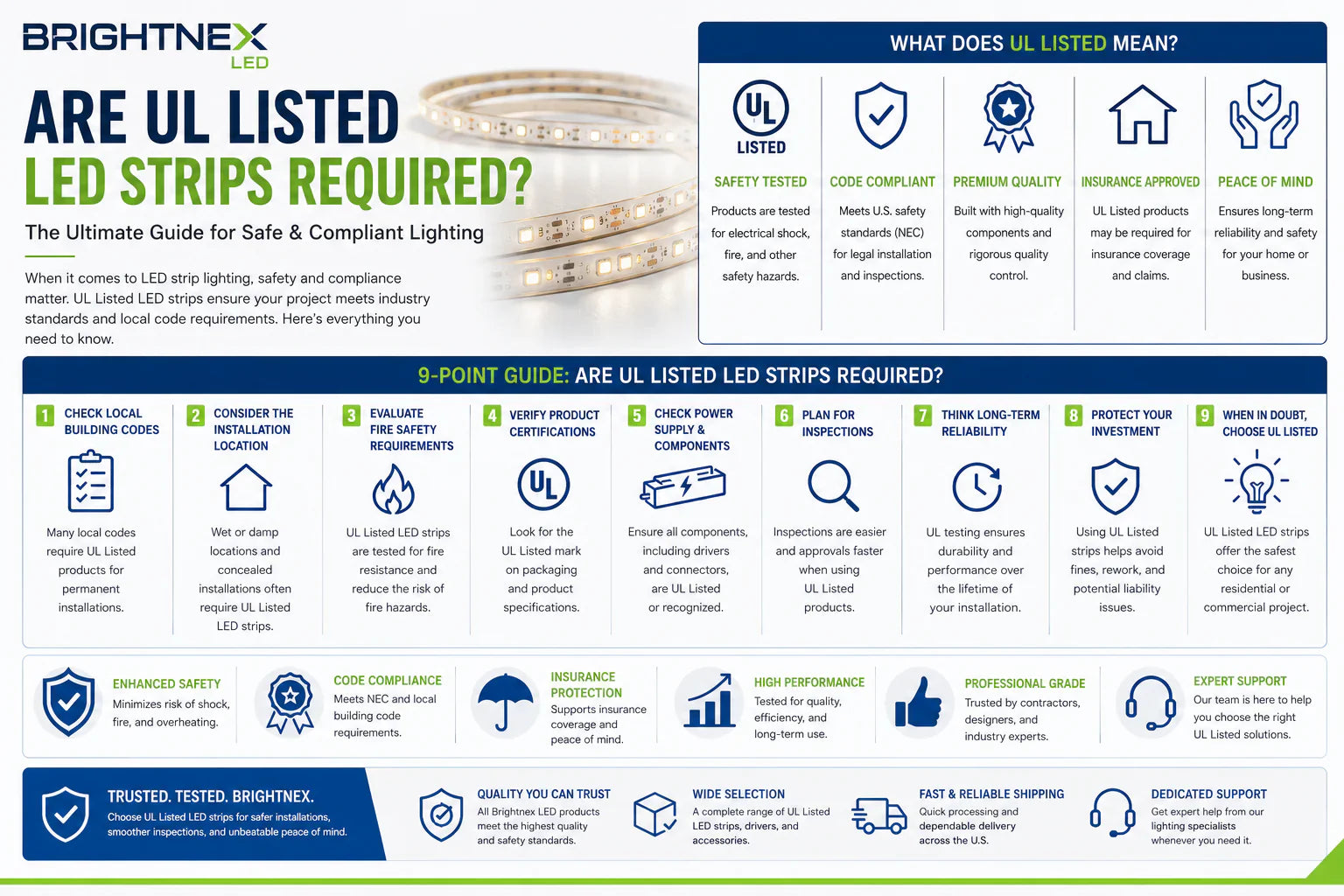
Are UL Listed LED Strip Lights Required? What Contractors and Inspectors Need to Know
A failed inspection rarely begins with questions about brightness or color temperature. More often, it starts when an inspector asks for product documentation, driver certifications, or proof that the LED strip lighting system meets recognized safety standards.
This is why contractors, electricians, builders, and lighting distributors frequently ask: Are UL listed LED strip lights required?
The answer is not always straightforward. Requirements can vary depending on the project type, local authority having jurisdiction (AHJ), and whether the lighting is considered a permanent part of the building's electrical system. However, for most professional installations, UL-listed LED strip lights are considered the safest and most practical choice.
Whether you're working on a luxury home in Los Angeles, a commercial tenant improvement project, or custom millwork with integrated lighting, using certified products can help avoid inspection issues, reduce liability, and improve long-term reliability.
Are UL Listed LED Strip Lights Required by Code?
The National Electrical Code (NEC) does not specifically state that every LED strip light must be UL listed. However, the code does require many electrical products to be listed, labeled, or approved when used in permanent installations.
In practical applications, UL listing becomes particularly important when LED strip lighting is integrated into a building's structure, including:
-
Under-cabinet lighting
-
Cove lighting
-
Toe-kick lighting
-
Built-in shelving
-
Custom millwork
-
Ceiling details
-
Architectural accent lighting
Because these systems become part of the building's electrical infrastructure, inspectors and specifiers commonly expect listed and approved products.
For professional contractors, the question is often not whether they can install an unlisted product—it is whether the entire system will pass inspection without creating delays or costly rework.
What Inspectors Typically Look For
Many people assume inspectors only care about seeing a UL mark on the LED strip itself. In reality, they evaluate the entire lighting system.
Key components often reviewed include:
-
LED strip lights
-
Power supplies and drivers
-
Connectors and wiring methods
-
Low-voltage cabling
-
Junction boxes
-
Location ratings (dry, damp, or wet)
For example, even a UL-listed strip may fail approval if it is paired with an unlisted driver or installed in a wet location without the proper environmental rating.
The focus is always on whether the complete system is safe, compliant, and installed according to manufacturer specifications.
When UL-Listed LED Strip Lights Are Practically Required
While code language can vary by jurisdiction, there are several situations where UL-listed LED strip lights are effectively required.
Projects Subject to Inspection
New construction, permitted remodels, commercial tenant improvements, and many electrical upgrades are routinely inspected. Using unlisted products can result in:
-
Inspection failures
-
Project delays
-
Material replacement costs
-
Additional labor expenses
Specification-Driven Projects
Architects, designers, and builders frequently require UL-listed products before materials are approved for installation.
This is especially common in:
-
Luxury residential projects
-
Hospitality environments
-
Retail spaces
-
Custom architectural applications
Liability-Sensitive Installations
In commercial, hospitality, multifamily, and public-facing environments, product certification plays an important role in risk management. Property owners often expect documented compliance and traceable safety standards.
Why UL Listing Matters in Luxury Residential Projects
High-end residential construction often demands a higher level of quality control than standard installations.
Homeowners investing in premium cabinetry, custom millwork, and integrated lighting systems expect products that are safe, reliable, and professionally documented.
In design-focused markets like Los Angeles, contractors often prefer UL-listed LED strip lighting because it offers:
-
Easier project approvals
-
Greater client confidence
-
Reliable dimming performance
-
Consistent product quality
-
Better long-term durability
When lighting is concealed behind expensive finishes, replacing failed components becomes significantly more costly than choosing certified products from the beginning.
Why Some People Believe UL Listing Is Not Required
Much of the confusion comes from consumer-grade LED strip products.
Many plug-in LED tape lights sold online are designed for temporary decorative use rather than permanent installation. While these products may be acceptable for certain low-risk applications, they are often unsuitable for professional construction projects.
Once LED strips become integrated into:
-
Cabinetry
-
Walls
-
Ceilings
-
Built-in furniture
-
Architectural details
The expectations for product certification and compliance become much stricter.
Additionally, there is an important difference between individual components carrying certifications and an entire LED strip system being properly listed for installation.
UL Listing Is Only Part of the Equation
Choosing a UL-listed strip light is an important first step, but a successful installation depends on the entire system working together.
Contractors should also evaluate:
-
Driver certifications
-
Wattage capacity
-
Dimming compatibility
-
Voltage drop considerations
-
Environmental ratings
-
Connector quality
-
Heat management
For example, a TRIAC dimmable residential installation may require different components than a commercial 0-10V dimming system.
Likewise, wet-location projects often require drivers and enclosures specifically rated for those environments.
How to Buy LED Strip Lighting That Passes Inspection
For contractors, electricians, and lighting distributors, the best purchasing strategy is simple: select products as if every installation could be reviewed by an inspector.
Before purchasing LED strip lighting, verify:
-
UL listing status
-
Driver certifications
-
Dimming compatibility
-
Dry, damp, or wet location ratings
-
Product documentation
-
Warranty coverage
Reliable suppliers should be able to provide complete specifications and technical documentation, not just marketing claims.
Standardizing around professional-grade strip lighting systems can also reduce installation errors and simplify future purchasing decisions.
The Hidden Cost of Non-Listed LED Strip Lights
A lower upfront price does not always mean lower project costs.
Using uncertified products can lead to:
-
Failed inspections
-
Replacement labor
-
Project delays
-
Warranty issues
-
Customer complaints
-
Damage to contractor reputation
For contractors and lighting resellers, the real value comes from products that install smoothly, perform reliably, and withstand scrutiny from inspectors, builders, and property owners.
Final Verdict: Are UL Listed LED Strip Lights Required?
For temporary decorative applications, UL listing may not always be mandatory.
However, for permanent residential, commercial, hospitality, and specification-grade installations, UL-listed LED strip lights are often expected and frequently necessary for approval.
When a project involves inspections, architectural integration, or long-term performance expectations, certified products provide a safer and more professional solution.
Rather than asking whether UL listing can be avoided, professional contractors should ask whether the risk of using uncertified products is worth the potential consequences.
In most cases, safer approvals, better documentation, and greater client confidence make UL-listed LED strip lighting the smarter investment.
FAQ Section
Are UL listed LED strip lights required by code?
Not always. However, many permanent installations, especially those subject to inspection, require listed or approved electrical products. Local authorities and project specifications often expect UL-listed LED strip lights.
What does UL listed mean for LED strip lights?
A UL-listed LED strip light has been tested to meet recognized safety standards for electrical products. This certification helps verify product safety and compliance.
Can I install non-UL-listed LED strip lights?
Non-listed LED strips may be acceptable for temporary or decorative applications, but they can create issues in permanent residential and commercial installations where inspections are required.
Do inspectors check LED strip light certifications?
Yes. Inspectors may review product markings, technical documentation, driver certifications, and installation methods to ensure the system complies with local codes.
Are UL-listed LED strip lights required for commercial projects?
Many commercial projects, tenant improvements, hospitality spaces, and retail environments specify UL-listed lighting products to meet safety and compliance requirements.
Why do contractors prefer UL-listed LED strip lights?
UL-listed products reduce inspection risks, improve project approvals, provide better documentation, and help ensure long-term reliability for clients.
Are drivers and power supplies required to be UL listed?
In many installations, inspectors evaluate both the LED strip and the driver. A UL-listed strip paired with a non-compliant driver may still create approval issues.
Where can I buy UL-listed LED strip lights in California?
Professional contractors and lighting distributors typically source UL-listed LED strip lights from reputable wholesale LED lighting suppliers that provide complete technical documentation and certified system components.