
8mm vs 10mm vs 12mm LED Strip Comparison for Professional Projects
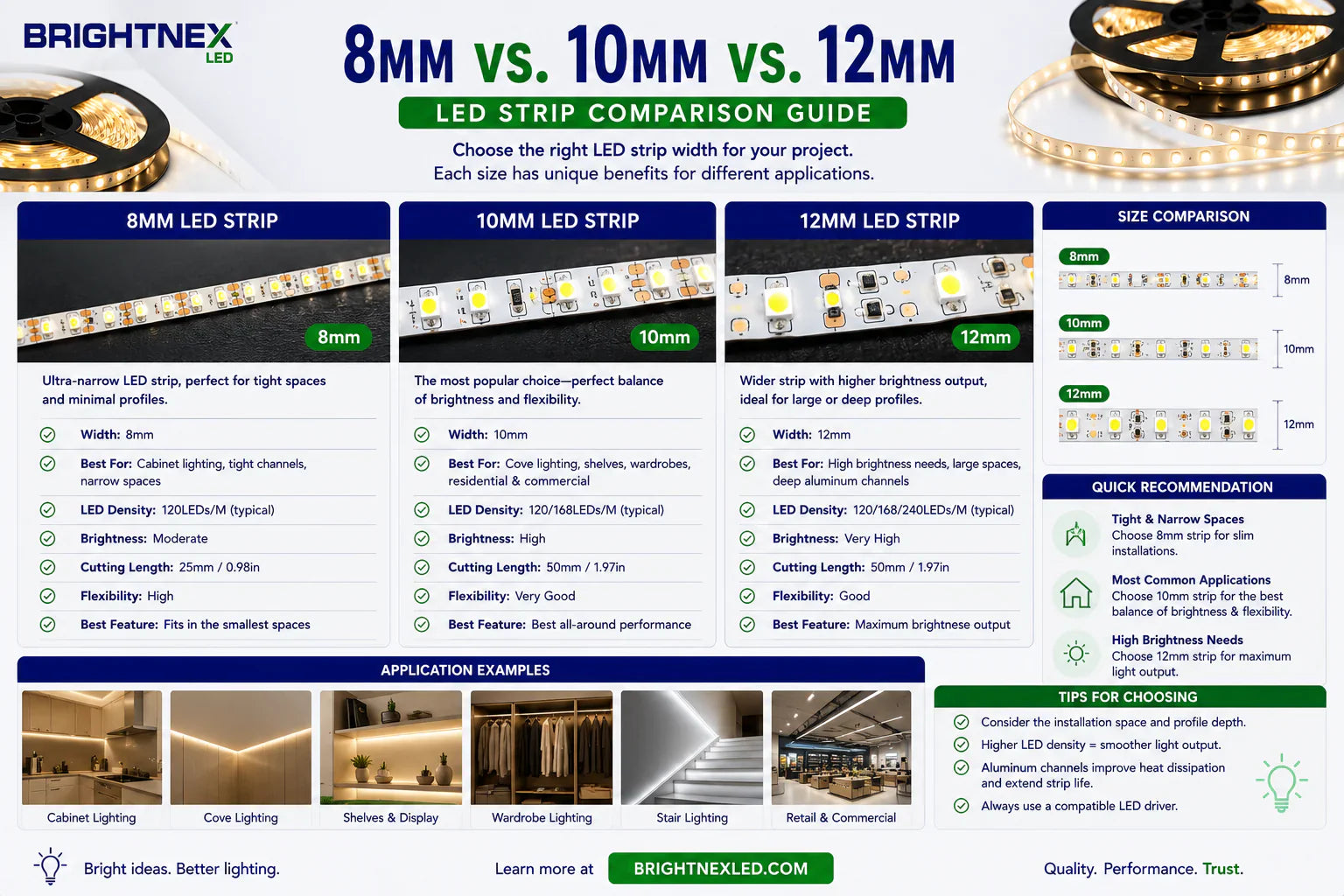
8mm 10mm 12mm strip comparison by application
At a practical level, 8mm strips are usually chosen when space is limited and the lighting detail is visually delicate. Think narrow aluminum channels, tight coves, shallow cabinetry, and refined residential accents where the fixture should disappear. In those conditions, 8mm can be the cleanest answer, especially for single-color or some compact tunable white layouts.
10mm strips often sit in the middle of the market because they balance flexibility with broader compatibility. For many contractors, 10mm is the safe choice when the project needs more output options, more common connector support, or a wider range of strip types without moving into a bulkier footprint. It works well across undercabinet runs, toe-kick lighting, display shelving, and general architectural accents.
12mm strips are usually selected when the lighting package needs more circuit complexity or more room on the tape itself. This is common in RGBW, CCT, and some higher-density COB or specialty strips where additional conductors, chip layouts, or performance targets require more width. In larger coves, premium retail displays, and high-end residential work, 12mm often gives the installer more capability with fewer compromises.
Width changes more than physical size
The mistake some buyers make is treating width as a purely mechanical dimension. In the field, strip width affects how the product handles heat, how many LEDs or chip structures can fit across the board design, and what category of accessories will work without modification.
A narrower board can be ideal when every millimeter counts, but it may limit the available configurations. A wider board often supports more advanced options, yet it may not fit the selected profile or corner detail. That trade-off matters most when the lighting is being integrated into finished millwork, stone, metal, or drywall reveals where adjustment later is expensive.
For wholesale buyers managing repeat installs, consistency matters just as much. Standardizing around one width can simplify stocking connectors, channels, clips, and controllers. But over-standardizing can create problems if one strip width is being forced into applications where it is not the best fit.
When 8mm makes sense
8mm is the practical choice when profile width is constrained or the visual line needs to stay extremely slim. It is especially useful in compact residential details where the designer wants light without hardware presence. In high-end projects, that can be the difference between a polished finish and an install that feels oversized.
The trade-off is that 8mm does not always offer the same range of advanced strip formats as wider boards. Depending on the strip family, options for RGBW, dense COB layouts, or connector availability may be more limited. Installers also need to check amp load, voltage drop planning, and profile heat dissipation carefully on longer runs.
Where 10mm is the workhorse
10mm is often the easiest width to specify across mixed-use residential and light commercial applications. It gives enough board space for a broad product range while still fitting many standard aluminum profiles used by electricians, cabinet trades, and lighting fabricators.
For procurement teams, 10mm is attractive because it can reduce special-order friction. It commonly aligns well with everyday accessories, from connectors to mounting channels, and it supports a wide range of white and color-changing strip categories. If a project has no unusual space restriction, 10mm is frequently the most forgiving option.
Why 12mm is often chosen for advanced strip types
12mm becomes the stronger option when the strip needs more functionality on the board. RGB, RGBW, CCT, and IC RGB formats often benefit from the extra width because the circuit design, solder pads, and chip arrangement demand more real estate. The result is not just a wider tape, but often a more capable system.
That matters on premium projects where tunable scenes, saturated color, or richer white performance are part of the specification. In those jobs, trying to force a narrower format can create unnecessary limitations. If the channel and mounting detail allow it, 12mm can be the cleaner technical choice.
Profile fit, connectors, and field labor
One of the most expensive mistakes in strip lighting is treating the strip and profile as separate decisions. Width must be checked against the actual interior channel dimension, lens fit, end caps, and any corner accessories. Nominal profile sizing is not enough. Adhesive backing, solder joints, and wire exit points all affect the fit.
Connector compatibility is another common issue. A strip may fit the profile but fail at the connection stage because the selected clip, tape-to-wire connector, or corner joiner does not match the board width and pad layout. For production-oriented buyers, this is where standardization pays off. Matching strip width to a proven accessory set saves labor and reduces field improvisation.
In luxury homes, neat terminations matter. Wider strips may require slightly more planning at turns, transitions, and feed points, but they can also provide better pad access for professional soldering on complex color-changing systems. Narrow strips can disappear visually, but they demand more precision from the installer.
Output, heat, and control strategy
Width alone does not determine brightness, but it often correlates with the type of strip that can be built. More board space can support denser chip arrangements, broader circuit options, or specialty constructions such as COB and SCOB. That is why wider strips are common in premium applications where smooth dot-free light, color control, or higher output matters.
Heat management also deserves attention. If a project is pushing higher wattage, the aluminum profile is not just a trim accessory. It is part of system performance. A 12mm strip in a properly sized profile may be a better long-term solution than a tighter 8mm installation with less room for thermal management. It depends on run length, ambient conditions, and the actual wattage per foot.
Control strategy can influence width selection too. Single-color systems may work well in narrower formats, especially on straightforward dimming packages. Once the project moves into CCT, RGBW, or pixel-style effects, the board width usually needs to support more channels and cleaner termination points. Trade buyers should evaluate the strip together with the controller, driver, and installation environment from the start.
Which width should trade buyers stock?
If your business handles mostly straightforward white strip jobs, 10mm is often the best inventory anchor because it covers a broad middle ground. If your clients regularly specify hidden linear details in millwork or very narrow profiles, 8mm deserves a place because it solves space problems that wider tape cannot. If your pipeline includes luxury residential, advanced color-changing work, or high-density COB and CCT systems, 12mm becomes more important.
Many professional buyers do not need one winner. They need a rational stocking plan. That usually means carrying widths by application class instead of trying to make one strip fit every project. BrightNex LED serves this kind of trade demand with multiple strip widths and control-friendly product categories designed for professional installation, including UL-marked options used in high-end US residential projects.
The smartest buying decision is the one that reduces callbacks, protects finish quality, and keeps accessory compatibility predictable
If the profile is tight, start with 8mm. If the job is general-purpose, 10mm is often the efficient choice. If the project needs more channels, more advanced color control, or a stronger platform for premium strip types, 12mm usually earns its space. Pick the width the install actually needs, and the rest of the system gets easier.
FAQ
What is the difference between 8mm, 10mm, and 12mm LED strips?
The primary difference is PCB width. Wider strips often support more advanced features, higher-density layouts, and additional color channels, while narrower strips fit tighter profiles and architectural details.
Which LED strip width is best for under-cabinet lighting?
For most under-cabinet applications, 8mm and 10mm strips are the most common choices because they fit standard aluminum channels while maintaining a clean appearance.
When should I use a 12mm LED strip?
12mm strips are ideal for RGBW, CCT, IC RGB, and other advanced lighting systems that require additional circuitry and connection points.
Does strip width affect brightness?
Not directly. Brightness depends on wattage, LED density, and strip design. However, wider strips often support higher-performance lighting configurations.
Which LED strip width is easiest to stock for wholesale projects?
Many contractors and distributors choose 10mm as their primary inventory width because it offers the best balance of compatibility, performance, and application flexibility.